Related: Pickleball Paddle Core Thickness, Explained
There is no best paddle. There is only the paddle that fits the hand holding it, and that is the first thing I tell every member who asks me which carbon fiber pickleball paddles to buy. It is rarely the answer they want. The paddle market is roughly 90 percent marketing and 10 percent graphite, and most players would improve faster from six lessons than from a paddle that costs more than their shoes.
I coach at a club with 400 members in Naples, Florida, from juniors to the 70-and-over league, and I run a demo program specifically so members stop buying gear off influencer videos. That program has taught me that sweet spot size beats raw power for nine out of ten players, and that a paddle which feels amazing for one session and dead after six weeks is a failed product no matter how it played fresh.
The four paddles below cover the range I actually recommend: one tournament-level raw carbon face, one edgeless spin machine, and two sets that get a beginner, a couple, or a whole family on court without a second mortgage. Here is how I think about each of them, and what the specs on the box actually mean once you are standing at the kitchen line.
Best Overall: JOOLA Professional Pickleball Paddle
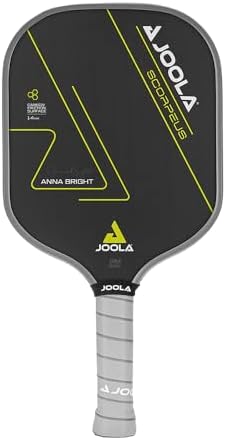
This is the paddle I point experienced players toward when they ask what the ceiling looks like. The line covers the Hyperion, Solaire, Perseus, and Scorpeus shapes in both Swift and Standard models, and the listing states USAP approval and tournament-level construction, which matters because approval is not something you want to be guessing about on the morning of a tournament.
The important spec is the raw carbon fiber surface. Raw carbon is a woven face that arrives with texture built into the material itself, rather than a grit coating sprayed on top of a smooth face. That distinction is the whole story of spin durability. Sprayed textures feel great in week one and slick by week six, especially in Florida humidity and heat. A woven raw carbon face holds its bite far longer, which is why it has become the default at the top of the market.
What you are buying here is control with spin. The ball sinks into the face a touch longer on a dink, which gives you a fraction more time to decide where it goes. If you are a 3.0 player who loses points to your own unforced errors, that forgiveness will not rescue you. If you are a 4.0 and up player who already keeps the ball in the court, this is the tool that lets you add pressure without adding power.
The honest caveat: this is the priciest option in this group, and some of that money goes toward pro sponsorships rather than the layup. Buy it when your game has caught up to it. Check current Amazon price.
Best for Spin: DGYGQ Edgeless Carbon Fiber Paddle
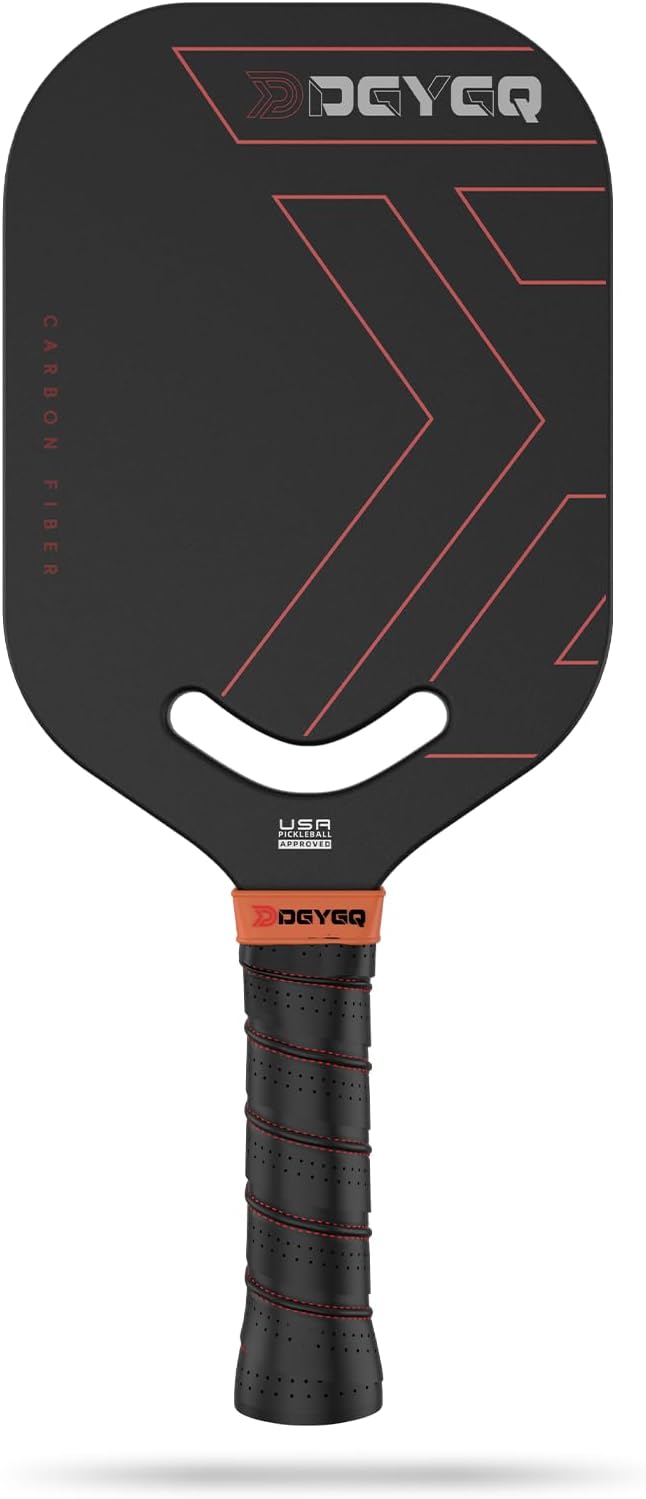
Edgeless versus edged is the design choice I get asked about most, so here it is in plain terms. A traditional paddle wraps a plastic edge guard around the perimeter. That guard protects the core, but it also creates a rim that the ball can catch when you are reaching for a low reset or digging out a drive at your feet. An edgeless paddle removes that rim, so the face runs all the way to the edge and there is nothing to snag.
This DGYGQ paddle pairs that edgeless build with a carbon fiber face and a polypropylene honeycomb core, which is the standard recipe for a face that grips the ball and a core that stays lively. The listing frames it around increased power and spin consistency, and the construction supports that: no edge guard means a slightly larger effective hitting area, and the carbon face gives you the friction to load a serve or a roll volley.
The tradeoff is durability, and I will not pretend otherwise. When you delete the edge guard, you expose the core edge to every court scrape and every bag toss. That is the single most common failure point on edgeless paddles, and it is why the cover that ships with it is not optional in my book. If you drag your paddle across the court surface on low balls, an edged paddle will outlast this one. If you want the cleanest swing path and the most spin available at this price, the edgeless build is worth the care it demands. Check current Amazon price.
Best Set for Beginners and Families: niupipo Paddle Set
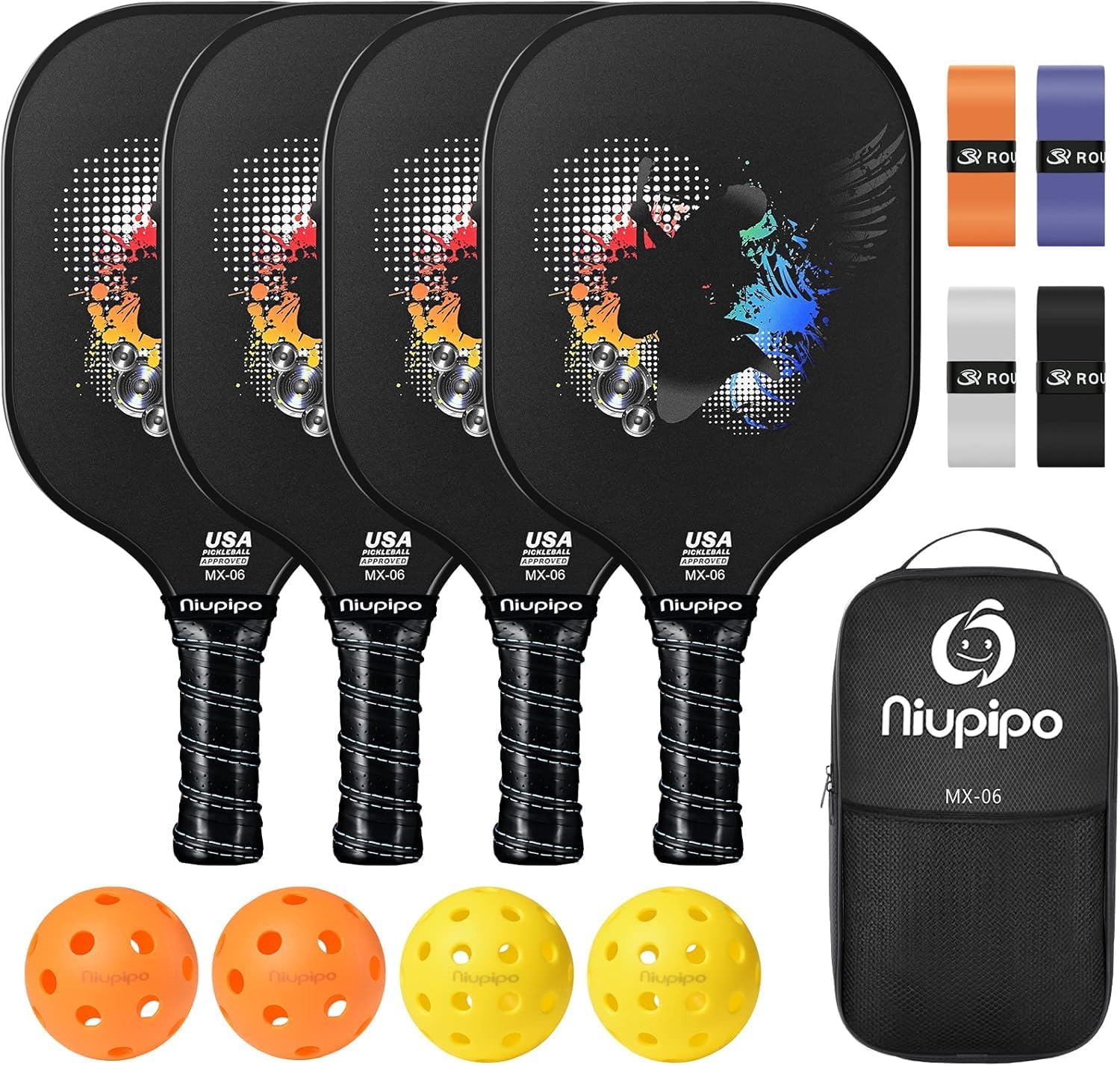
If you are buying your first paddle, or buying for a household, this is the practical answer. The set comes in configurations of two, four, or one, and includes a bag or cover depending on which you choose, so you are not hunting for a case afterward. The face is a carbon fiber and fiberglass hybrid, the core is polypropylene honeycomb, and the grip is a cushioned 4.72 inches.
That hybrid face is the smart part for a newer player. Pure carbon gives you maximum grit and a firmer feel, but it also transmits every mishit straight into your arm. Fiberglass softens that response and adds a little free pop, which is exactly what a beginner wants while they are still learning to make contact in the middle of the face. The phrase the listing uses, easy power, is a fair description of what that combination does.
The 4.72-inch grip deserves a mention because grip size is the most ignored spec in the sport. Players with larger hands who cram onto a 4-inch handle end up squeezing, and squeezing kills your wrist snap on serves. A cushioned grip in this range is more forgiving, and it also survives humidity better than a thin, hard wrap. If your grip tape disintegrates every summer, that is a fit problem as much as a tape problem.
The listing states USAPA approval, which matters for tournament play, but do the two-minute check yourself against the current approved paddle list before you register for anything sanctioned. I have seen too many players show up with a paddle they believed was approved and find out otherwise at check-in. Check current Amazon price.
Best Midweight Set for All Levels: RONIK Carbon Graphite Set by POACH PICKLEBALL
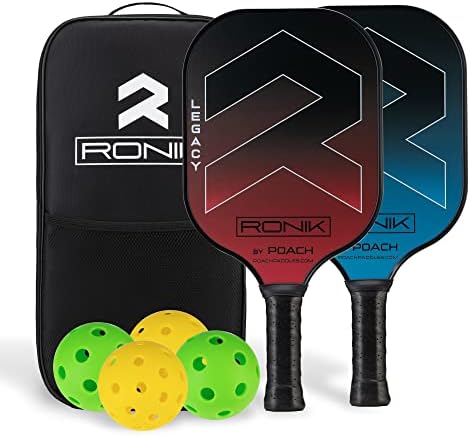
This one is the set I would hand to two friends who want to start playing together this weekend. You get two carbon graphite paddles in red and blue, four balls, and a bag, all in one box. That is a complete start, not a starter kit that leaves you buying the rest separately.
The number that matters here is the 14mm poly core. Core thickness is the dial that controls the tradeoff between power and control. Thin cores are lively and fast, thick cores are plush and forgiving. Fourteen millimeters sits right in the middle, which is why it is the most common thickness among recreational players. You get enough pop to put a ball away when you have the opening, and enough dwell time that your dinks and resets do not launch off the face.
Midweight is the other sensible choice for this audience. A heavier paddle absorbs pace and feels stable on blocks, but it tires your shoulder over three sets. A lighter paddle swings fast but gets pushed around by hard hitters. Midweight is the compromise that lets a player develop without fighting the equipment.
Carbon graphite on the face gives you a firmer, more predictable response than a fiberglass blend, so this set will carry a player further up the ladder than a pure beginner set will. If you already own a paddle and you are shopping for yourself alone, a set is wasted money. If you are buying for a pair or a family, this is the best value in this article. Check current Amazon price.
What the specs actually mean
The spec sheet is not the whole story, but four numbers tell you most of what you need to know.
Sweet spot size. This is the first thing I evaluate and the last thing the marketing mentions. The sweet spot is the area of the face where the ball comes off with predictable pace and no twist. A big sweet spot covers your mishits, and for most players it is worth more than any power rating. Wide-body and standard shapes generally offer more forgiveness than elongated shapes, which trade forgiveness for reach and swing speed. If you are between levels, take the forgiveness.
Core thickness. Thin means power, thick means control. There is no magic thickness, only the one that matches your game. If you lose points because your dinks pop up, go thicker. If you lose points because you cannot finish a point, go thinner.
Core construction. Thermoformed versus non-thermoformed is the only real technology story in the last three years. Thermoforming bonds the face to the core under heat and pressure, which produces a more consistent, more durable bond and typically a livelier face. It is spreading down the price range, and I expect it to be standard everywhere within a couple of years, after which the marketing will move on to core materials.
Face texture. Two kinds exist: texture woven into the material, like raw carbon, and grit sprayed onto a smooth face. Woven texture lasts. Sprayed texture does not, particularly in heat and humidity. When a paddle feels amazing for a month and then goes dead, the face texture is usually the culprit, not the core.
Two more practical notes. Edge guards catch the ball on low resets, which is the argument for edgeless designs, but they also protect the core from court rash, which is the argument against them. And grip size is real: too small and you squeeze, too large and you lose wrist snap. Measure before you buy.
Finally, a word on sets versus single paddles. A set makes sense when two people are starting at the same time or when a household needs a spare. A single paddle makes sense when you know your game and you are shopping for one specific feel. Do not buy a set for yourself out of habit.
Paddle reference table
| Paddle | Construction | Core and feel | Best for | Price |
|---|---|---|---|---|
 Visit on Amazon → JOOLA Professional Pickleball Paddle |
Raw carbon fiber surface, USAP approved, tournament level | Firm face, spin retention over time | 4.0 and up, tournament players | Check current Amazon price |
 Visit on Amazon → DGYGQ Edgeless Carbon Fiber Paddle |
Edgeless carbon fiber face, polypropylene honeycomb core | Clean swing path, spin and power | Spin chasers, low-ball specialists | $69.98 |
 Visit on Amazon → niupipo Paddle Set |
Carbon fiber and fiberglass hybrid, honeycomb core, cushioned 4.72 inch grip | Forgiving, easy power | Beginners, families, larger hands | $69.99 |
 Visit on Amazon → RONIK Carbon Graphite Set by POACH PICKLEBALL |
Carbon graphite face, 14mm poly core, midweight, two paddles plus balls and bag | Balanced power and control | Two players starting together, all levels | Check current Amazon price |
Should you buy the JOOLA Professional Pickleball Paddle?
Yes, if you play at a level where spin and control decide points. The raw carbon surface is genuine woven texture rather than a sprayed coating, and the model range is wide enough that you can match the head shape and weight to your swing instead of adapting your swing to the paddle. It is the most expensive route here, and part of that price is the pro sponsorship markup I complain about constantly. Buy it when your game has caught up to the equipment, not before. Check current Amazon price.
Should you buy the DGYGQ Edgeless Carbon Fiber Paddle?
Yes, if spin and a clean swing path are what you are chasing. Removing the edge guard means nothing catches the ball on a low reset, and the carbon face gives you the friction to load serves and roll volleys. Go in with your eyes open about the tradeoff: an exposed core edge is the first thing to take damage, so keep it in the cover between games. If you scrape your paddle off the court surface on every low ball, choose an edged design instead. Check current Amazon price.
Should you buy the niupipo Paddle Set?
Yes, if you are outfitting a household or buying for a beginner. The hybrid carbon and fiberglass face softens mishits and adds free pop, the cushioned grip suits larger hands, and the set arrives with a bag. Verify the model against the current USAPA approved list before you enter a sanctioned event, because that is a detail worth confirming yourself. For casual and recreational play, it does the job and leaves money for lessons, which will help you more. Check current Amazon price.
Should you buy the RONIK Carbon Graphite Set?
Yes, if two people are starting at the same time or you want a spare in the bag. The 14mm poly core is the middle of the road in the best sense, midweight keeps it manageable over three sets, and the box includes balls and a bag so you can play the day it arrives. If you already know your game and you are shopping for one paddle with a specific feel, buy a single paddle instead and spend the difference on court time. Check current Amazon price.