I keep a demo bag in the truck, and on any given Tuesday there are four carbon fiber pickleball paddles in it that members of my Naples, Florida club want to hit before they spend their money. I have coached at a 400 member club since 2019, played tennis through college before that, and I have watched this sport turn into a gear arms race where the spec sheet on the box rarely matches what happens on court in July humidity. This comparison covers four carbon fiber pickleball paddles at four very different price points: a four pack family set, two raw carbon builds aimed at spin and dwell time, and one thermoformed frame that reads like a spec sheet from two years in the future.
The short answer: for the recreational majority, the Warping Point Neon Gen 3 carries the most real paddle technology in this group, because a thermoformed frame with a 16mm core is the one design choice in modern paddles that genuinely changes how a paddle plays. If you need four paddles for a family or a loaner bin, the GARYE set is the only sensible answer here. If you are a 4.5 and up banger who wins with pace, the Engage Pursuit Pro1 is aimed straight at you. The JOJOLEMON sits in the middle and asks one question: do you want a control-first face or a power-first face?
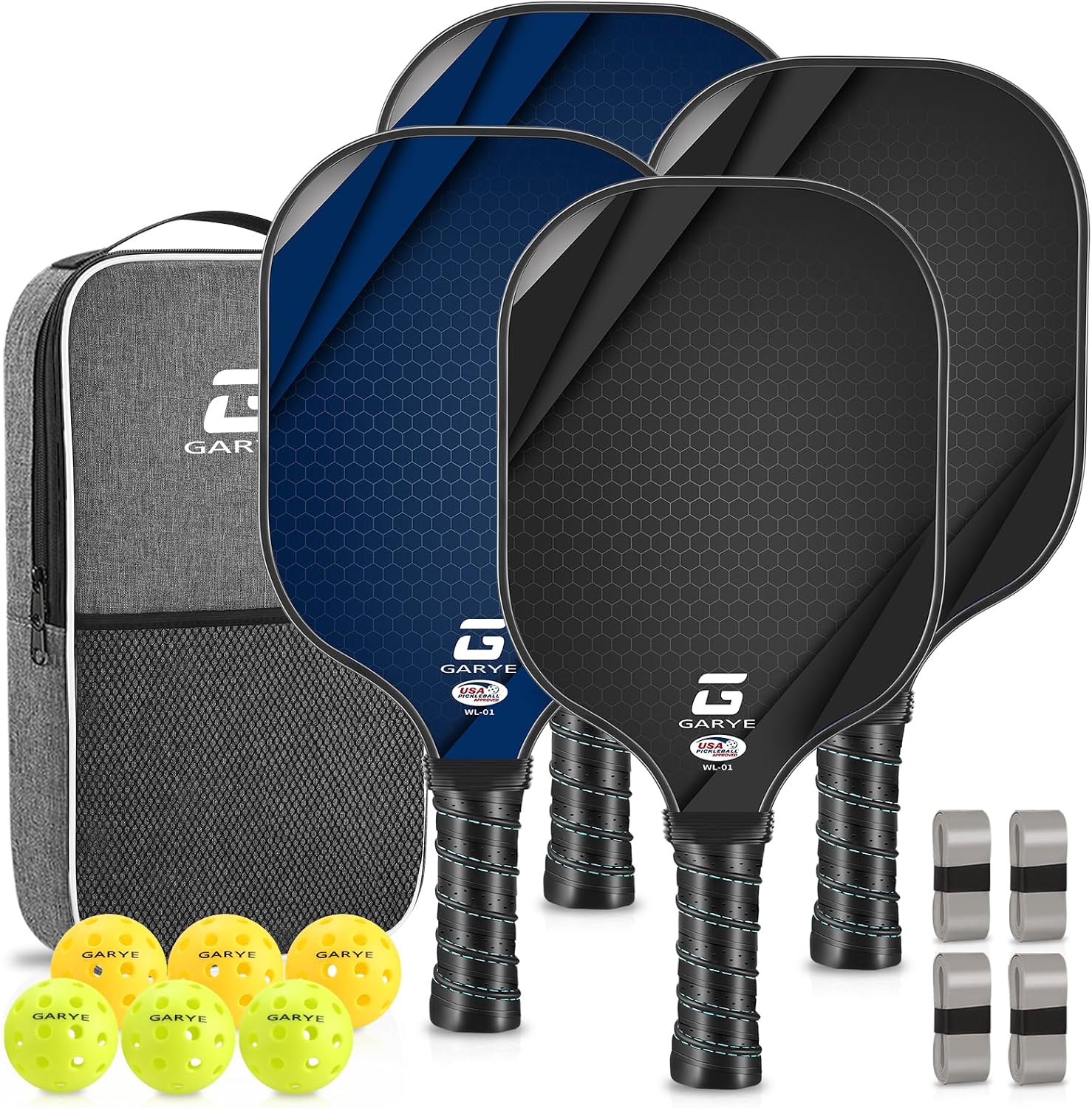
GARYE Pickleball Paddles Set of 4Visit on Amazon
Four carbon fiber paddles, six balls, a bag, and grip tape in one box; listed as USAPA approved; the cheapest way to get a whole household or a club loaner bin on the court
Four paddles at this price means each one is built to a budget, and the face texture is usually the first thing to go
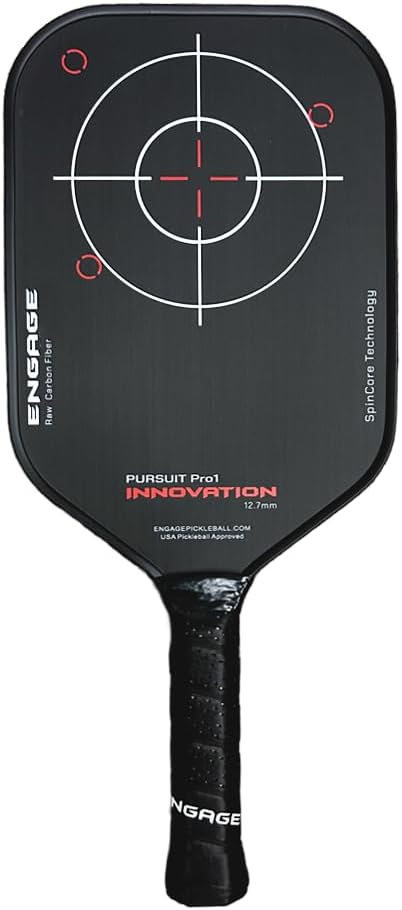
Engage Pursuit Pro1 Pickleball PaddleVisit on Amazon
Raw carbon fiber face marketed for extreme power, spin, and dwell time; built for aggressive power players who create their own pace
A power-first build asks you to control it, and players under 4.0 usually cannot
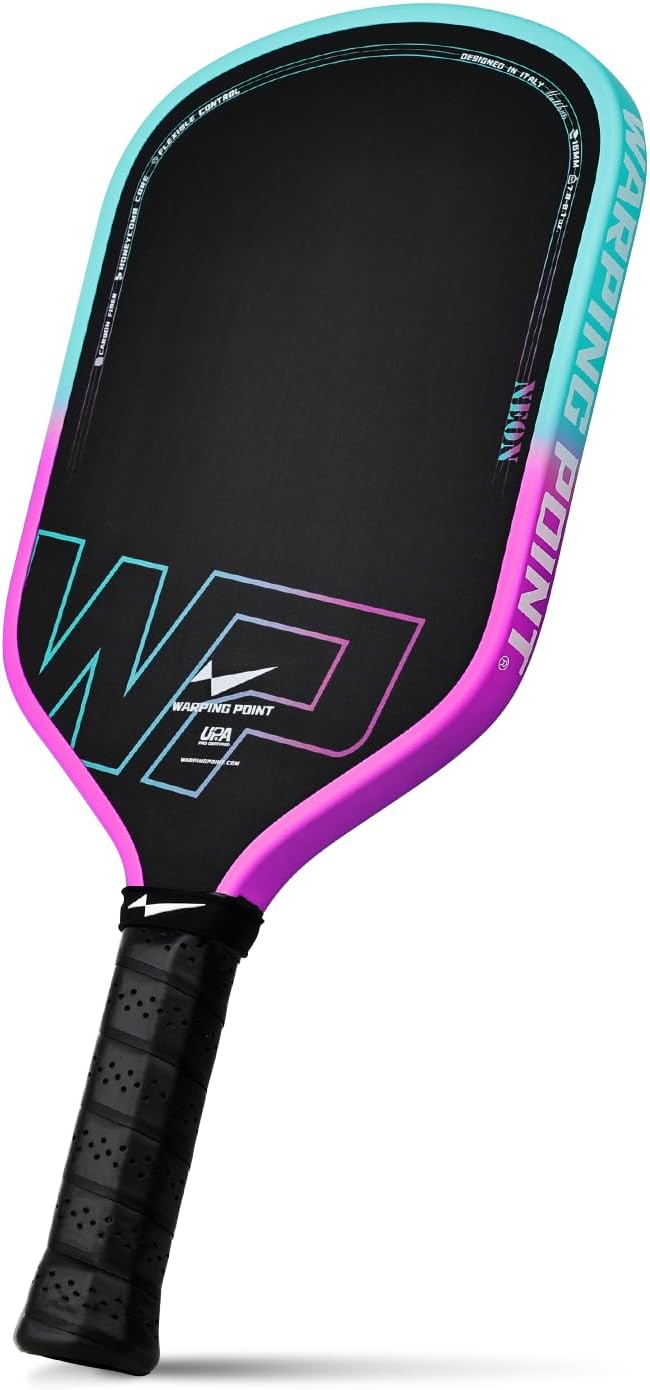
Warping Point Neon Gen 3 Pickleball PaddleVisit on Amazon
Triple-layer T700 raw carbon fiber, 16MM EdgeFusion core, thermoformed frame, UPA-A approved; the most technology per dollar in this group
Thermoformed frames still carry a premium, and not every tournament list treats UPA-A and USAPA the same way
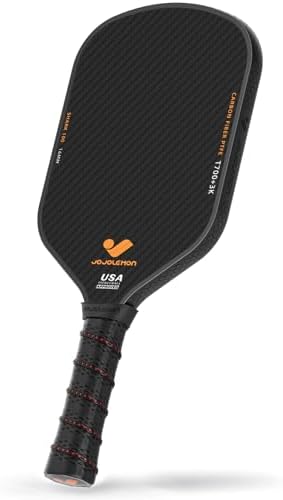
JOJOLEMON Pickleball PaddlesVisit on Amazon
Carbon fiber face over a 16mm Shark Power polymer core, designed for spin and consistency; the classic modern control formula
No stated approval listing for the big sanctioning bodies, so check before you enter a tournament
Prices and availability were captured from Amazon Creators API and may change.
What a comparison table cannot tell you
A table can list core thickness, face material, and approval claims. It cannot tell you whether the sweet spot is where you actually hit the ball, and that is the only question that matters after the first month.
I have said this to members for years: core density numbers mean nothing without the same player swinging both paddles on the same day. Two paddles can both say 16mm and raw carbon fiber and feel nothing alike, because the way the core is bonded to the face and the way the edge is finished change the feel more than the spec sheet admits. That is why I run every demo the same way. One player, two paddles, ten minutes of dinks, ten minutes of drives, then a switch. No influencer video, no launch-day hype. If a paddle only feels good in the first session and goes flat by week six, it failed, no matter how it played on day one.
So read the table as a starting point. The rest of this article is about the parts the table leaves out.
The four paddles, one at a time
GARYE Pickleball Paddles Set of 4: the family pack
The GARYE set is a four pack of carbon fiber paddles with six balls, a bag, and four grip tapes, and it is listed as USAPA approved. As a starter purchase for a family of four, or as the bin of loaners at the back of a club, this is the value play in the group. You get four people on a court for less than the price of one premium paddle.
What you give up is refinement. Four paddles at this price point means each paddle is built to a budget, and the two things that go first on budget builds are the grip tape and the face texture. If you live somewhere humid, plan on replacing the grips within a season, because the stock tape on inexpensive paddles tends to turn slick before the face does. My other warning is the approval claim itself. Paddles that arrive unapproved while advertising approval are a genuine problem in this sport, so if you are entering a sanctioned event, look your model up on the current approved list rather than trusting the box.
For a beginner, a kid, or a spouse who plays twice a month, none of that matters much. This is the set I hand out when someone asks what to buy before they even know if they like the sport.
Engage Pursuit Pro1: the power build
The Engage Pursuit Pro1 is a raw carbon fiber paddle marketed for extreme power, spin, and dwell time, and the listing says it plainly: designed for aggressive power players. Dwell time is the phrase worth understanding. It describes how long the ball stays on the face before it leaves, and a longer dwell gives a strong player more time to load the ball with spin and more forgiveness on off-center contact.
Here is my honest read after five years of handing paddles to members. Power is the easiest thing to sell and the hardest thing to use. If your swing is short and compact and you drive the ball flat through the court, this paddle rewards you. If you are a 3.0 who blocks and dinks and occasionally swings hard, the extra pop turns your best shots into your worst errors, and you will spend three months learning to take pace off instead of adding it.
That is not a knock on the paddle. It is a knock on buying the paddle your favorite pro uses when your game does not look like theirs. If you are 4.0 and climbing and you want a face that lets you shape the ball, this belongs on your demo list.
Warping Point Neon Gen 3: the tech-forward pick
The Warping Point Neon Gen 3 lists triple-layer T700 raw carbon fiber, a 16MM EdgeFusion core, a thermoformed frame, and UPA-A approval, with tour-level spin, control, and power claimed. On paper this is the most interesting paddle in the group, and it is the one I would put in the hands of a 3.5 to 4.5 player who wants a single paddle that covers both ends of the court.
Thermoforming is the reason. I have been saying for a couple of years now that thermoformed versus non-thermoformed is the only real technology story in this sport in the last three years, and this paddle is a good example of why. The process bonds the core to the face under heat and pressure, which stiffens the whole structure and changes how the perimeter responds on off-center hits. Whether the marketing language around it is overblown is a fair debate. Whether the construction is meaningfully different from a glued-up paddle is not.
One practical note: the listing says UPA-A approved, which is not the same as USAPA approved, and different tournaments and leagues recognize different lists. Before you register for anything, check the approved list for that specific event. I have watched players show up with a paddle they assumed was legal and spend the morning arguing at the check-in table.
JOJOLEMON: the control-first spin build
The JOJOLEMON paddle pairs a carbon fiber face with a 16mm Shark Power polymer core and is marketed for ultimate spin and consistency. That combination, a textured carbon face over a 16mm core, is the standard modern control formula, and for a lot of players it is the right one.
A 16mm core is the thickest common option, and thickness is the simplest spec in the sport to understand. Thicker means a softer feel, a more forgiving sweet spot, and less free pop. Thinner means more power and a smaller margin for error. If your game is built on dinks, resets, and third-shot drops, a 16mm core with a gritty face is exactly what you want, because it lets you absorb pace instead of redirecting it.
The trade-off is that a control-first paddle will not bail you out when you need a put-away. You generate that yourself. The other thing to verify is approval status, because the listing does not spell out a sanctioning body claim the way the Warping Point and GARYE listings do. For rec play that is a non-issue. For tournament play, look it up first.
What core thickness actually does
Three of these four paddles are built around a 16mm core, and that is not a coincidence. Sixteen millimeters has become the default for anyone who values control, because it gives you the largest usable hitting area of the common thicknesses and takes the edge off hard incoming balls.
The cost is pop. A thicker core absorbs energy, so you have to swing through the ball to get pace. For a player with a full swing and decent mechanics, that is a good trade, because it means the ball goes where you aimed it. For a player who wins by blocking and redirecting, it is also a good trade. The players who should look elsewhere are the ones whose entire game is a flat, hard drive from the baseline, and there are not as many of those at the club level as the marketing suggests.
Thermoformed versus non-thermoformed
This is the section I would read twice if I were spending my own money.
A non-thermoformed paddle is essentially layers glued and pressed together. A thermoformed paddle is bonded with heat and pressure so the core, face, and edge form a stiffer single unit. The practical difference shows up at the edges and on off-center contact. A stiff perimeter loses less energy when you catch the ball near the frame, and it holds up better over a season of hard play.
My prediction, and I keep a dated list of these that I score every January: thermoforming becomes standard at every price point within two years, and once it does, the marketing will move on to core materials. Watch the used market for the 2025 hype paddles selling at half price. That tells you what actually held up better than any launch review.
Sweet spot beats raw power for nine out of ten players
I coach a 70 and over league and a group of juniors, and the lesson is identical at both ends of the speed spectrum. The player who finds the center of the paddle more often wins. You do not need power you cannot control, and a bigger sweet spot is worth more than a higher top-end speed number, because most points at the club level end on an error, not a winner.
That is why my default recommendation for the recreational majority in this group is the control-oriented side of the table, and why the four pack makes sense for anyone who has not yet figured out their own game. Buy the paddle that forgives your miss, then earn the right to buy the paddle that punishes the ball.
Durability: what actually kills a paddle
Edges chip. Faces peel. Grit wears smooth. Grip tape turns to paste in Florida humidity. Those four failure modes end more paddle lives than anything else, and none of them show up in the first week.
When you evaluate any of these four, think in three-month blocks, not first impressions. If the edge guard catches the ball on resets, it will keep catching it in month three. If the face texture feels aggressive now, ask whether it still will after sixty sessions. The brands that fix their edge guards and keep their face texture alive are the ones that earn my repeat recommendations, and price is a poor predictor of which brands those are.
Who should buy which
For a family, a beginner, or a club loaner bin, buy the GARYE set and spend the savings on a lesson. For a 3.5 to 4.5 all-court player who wants one paddle for both ends, the Warping Point Neon Gen 3 is the pick in this group, mostly because of the thermoformed frame and the 16mm core. For a 4.0 and up power player with a compact, aggressive swing, the Engage Pursuit Pro1 is the purpose-built option. For a dinker and reset specialist who wants spin and consistency and plays rec or league rather than sanctioned tournaments, the JOJOLEMON is a defensible buy.
What I am watching next
Two things. First, whether thermoformed construction reaches the entry price point, because the day a four pack is built that way is the day the budget tier stops being a compromise. Second, the used market in January, which will tell me which of the 2026 hype paddles actually survived a season of doubles. I will score both on my list and report back.
Until then, demo before you buy, and hit both paddles on the same day with the same partner. That test tells you more than any spec sheet, including this one.