A USAPA approved pickleball paddle set is the cheapest honest entry into this sport, and it is also where most beginners get burned. The photos all look alike, the bullet points all promise spin and control, and a month later the face is smooth, the edge guard is chewed up, and the core sounds like a wet cardboard box when you tap it.
I coach at a club with 400 members in Naples, Florida, and I watch this happen every season. A new player buys a set off a fifteen second video, plays three times a week for a month, then asks me why their dinks keep popping up. The paddle is usually the answer, not the technique.
The good news is that a decent entry set costs less than two private lessons, and the checks that separate a real paddle from a photo of one take about ten minutes. This guide covers the criteria I use, the two sets I hand to new members, and the exact steps to get your set playable on day one.
Why you should trust me
I played tennis through college, picked up pickleball in 2019, and now coach full time at a club with 400 members. Over five years I have demoed more than 60 paddles, and I keep a dated log on every one of them: spin rate, sweet spot size, and what the face and edge guard look like after three months of doubles play.
My feedback comes from both ends of the speed spectrum. The juniors I coach punish a paddle for being slow and mushy on put-aways. The 70-and-over league punishes it for being harsh on the arm and for grips that turn to paste in Florida humidity. When a paddle survives both groups for a full season, it earns a spot on my recommendation list.
I also do not care what a paddle looks like in a hero photo. I care what it feels like in week six, when the honeymoon is over and you are down 9-10 in the third game.
What separates a real paddle from a listing photo
Almost every starter set on Amazon claims USAPA approval. Some of them are approved. The only way to know is to look up the model name on the USA Pickleball approved paddle list, not the badge in the product image. A paddle that arrives unapproved is a paddle you cannot use in a sanctioned tournament, and it tells you the seller did not sweat the details.
Here is the short list of things that actually matter in an entry level set.
The core material. Polypropylene honeycomb is the standard, and it is what you want at this price. The core is where the money gets saved or spent, and it is the part you cannot see. A thin core dents and dies. If you can press the face with your thumb and feel it give, walk away.
The face material. Fiberglass is the entry level face, and there is nothing wrong with it. It plays soft, it has a big sweet spot, and it gives you easy power without much effort. Graphite and raw carbon faces cost more, last longer, and reward better technique. As a beginner, fiberglass is the right answer, because the sweet spot size beats raw power for almost everyone I coach.
The edge guard. This is the strip of plastic around the rim that protects the core. Cheap sets use a thin guard that cracks in the first month. Once it cracks, moisture gets in, the core swells, and the paddle goes dead. Run your fingernail along the guard. If it feels like tape rather than plastic, that is a problem.
The grip. Most adult paddles ship around 4.25 inches, which fits most hands. If you play in humidity, plan on buying overgrip tape, because the grip that comes in a starter set is the first thing to fail. That is a five dollar fix, not a reason to skip the set.
What comes in the box. At the entry level, balls and a bag are not marketing filler. You need both, and buying them separately adds up. A set that includes four balls and a bag gets you on court the same day.
The set size. Two paddles means you can play doubles with a partner. Four means you can hand paddles to the neighbors and grow the group. One means you are playing singles or you already have a partner with gear.
The two sets I would hand a new player
Neither of these is a $200 thermoformed paddle, and neither pretends to be. They are entry packages for players who are not sure the sport will stick, or who need to show up with four paddles for a family.
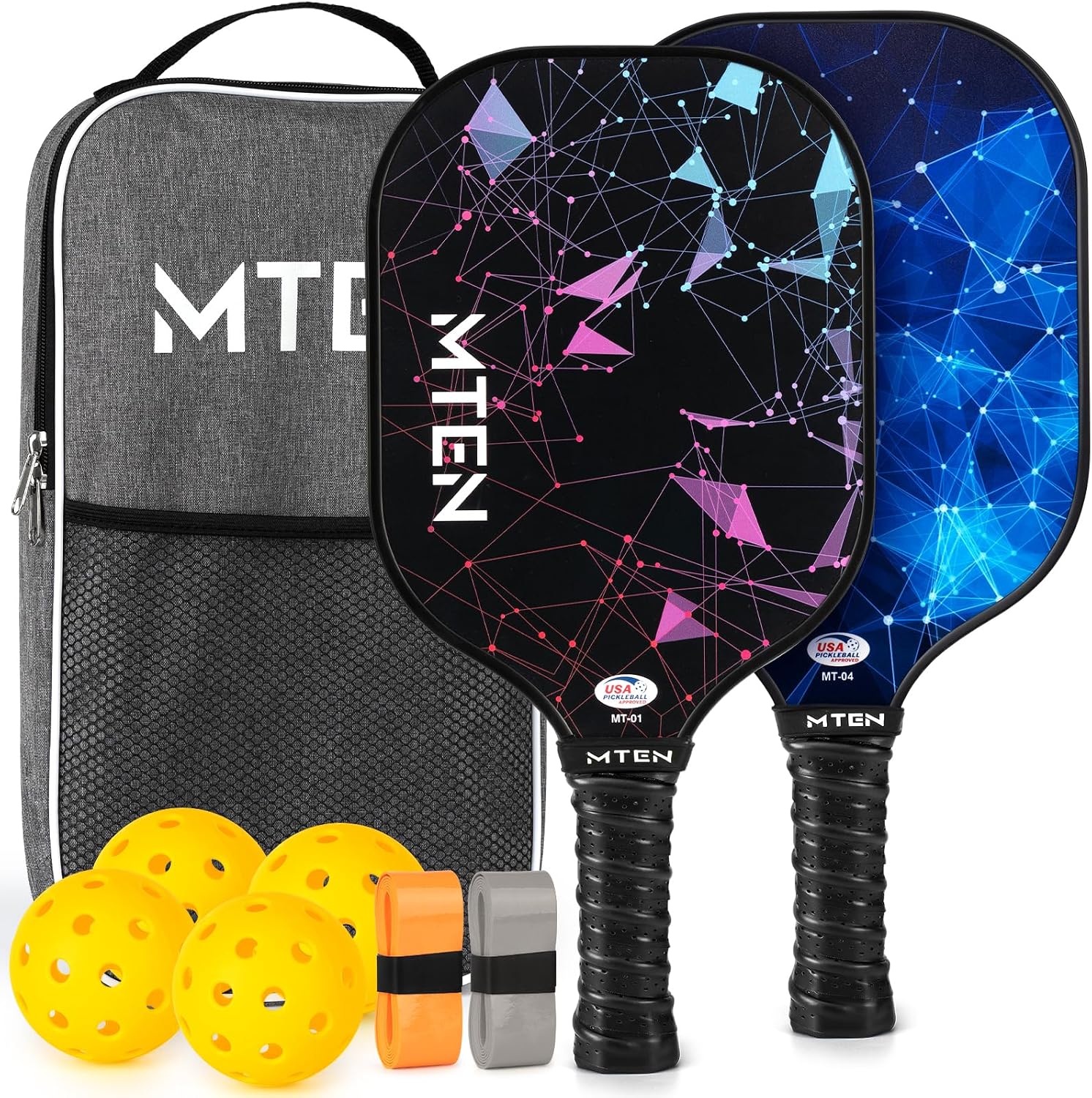
Budget pick: MTEN Pickleball Paddles Set of 2/4/1, USAPA Approved Fiberglass Rackets
 Visit on Amazon →
This is the set I point at when someone says they want to try pickleball this weekend and does not want to think hard about it. It is USAPA approved, the face is fiberglass, and it comes as a set of two, four, or one, which is the detail I like most. One person can buy a single paddle, a couple can buy two, and a family can buy four, all from the same listing. That flexibility matters when you are the person who always ends up supplying gear for the group.
Fiberglass gives you a soft feel and a generous sweet spot, which is exactly what a new player needs. The tradeoff is durability. Fiberglass faces are the least wear resistant option, and the grit that helps you generate spin wears smooth faster than it does on a carbon face. That is not a defect, it is the price of the category, and it is why I tell beginners to expect to replace an entry paddle in a year or two rather than five.
What to check when yours arrives: press the face with your thumb for soft spots, run a fingernail along the edge guard for cracks, and tap the face in a few places. It should sound the same all over. If one corner sounds flat, send it back before you play with it.
Flaws but not dealbreakers: The included grip will get slick in a Florida summer, so budget for overgrip tape. The face texture will fade with heavy play, which costs you spin, not control.
Anyone buying gear for a household, a workplace lunch league, or a first doubles match with a friend will get their money's worth here.
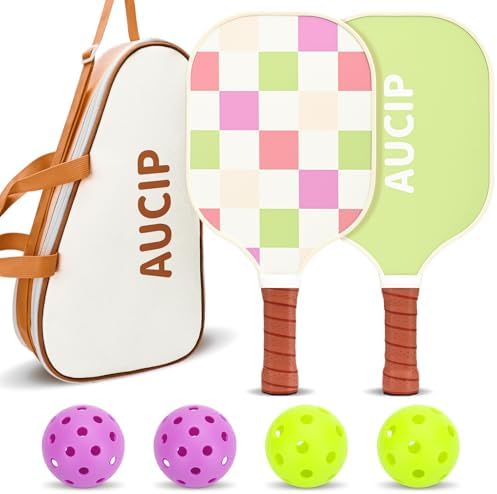
Runner-up: Pickleball Paddles, USAPA Approved Cute Pickleball Paddles Set of 2/4, Polypropylene Honeycomb Core, Fiberglass Pickleball Set with 2 or 4 Pickleball Rackets, 4 Balls, 1 Bag for Women
 Visit on Amazon →
This one wins on the box contents. You get the paddles, four balls, and a bag, which means a pair of players can order it and walk onto a court with nothing else in hand. The core is polypropylene honeycomb, the face is fiberglass, and it is USAPA approved. It is built for women and it comes in a set of two or four, so it fits the same buy pattern as the MTEN set above.
The polypropylene honeycomb core is the right choice at this tier. It is light, it is cheap to manufacture, and it is the same core family used in paddles that cost three times as much. What differs is core density and wall thickness, and those are the numbers a spec sheet will not tell you honestly. The only way to judge is to play with it, which is why I tell players to give any new paddle four sessions before they form an opinion.
Here is the honest caveat. A set built to a lower price point will not feel like a $200 thermoformed paddle. It will feel softer, it will have less plow-through on hard drives, and it will twist a little more on off-center hits. That is fine. You do not need power you cannot control, and you do not need a paddle that outperforms your footwork. A big sweet spot and a soft face will win you more recreational points than a stiff power paddle ever will.
Flaws but not dealbreakers: The bag is a basic tote, not a thermal or padded backpack, so do not expect it to protect paddles in a hot car. The cute graphics are the selling point for some buyers and a dealbreaker for others. Ignore the graphics and judge the core.
Anyone shopping for a gift, a mother-daughter pair, or a beginner who wants a complete package on day one should start here.
How to choose your first set, step by step
Step one: Count your players. If you are buying for yourself and one partner, a set of two is right. If you are the designated gear person for a foursome, a set of four saves money and arguments. Do not buy four paddles because they are cheaper per paddle if three of them will sit in a closet and lose their grip tack.
Step two: Verify USAPA approval yourself. Search the model name on the USA Pickleball approved list. Do this before you order, not after. Approval matters for tournaments and it is a decent proxy for build quality, because a seller who bothered to submit a paddle to the testing process usually bothered with the rest of it too.
Step three: Choose fiberglass if you are new. Fiberglass is softer, cheaper, and more forgiving than carbon. Carbon faces reward players who already generate their own spin and control. If you are still learning to keep the ball in the court, the more forgiving face is the better face.
Step four: Check the core, not the claims. Look for polypropylene honeycomb and a core you cannot easily compress with your thumb. Ignore words like "power core" and "tournament grade" unless there is a number attached, and even then, be skeptical.
Step five: Think about the grip before you think about the color. Grip circumference and grip condition affect your hand more than any other spec. If you have larger hands, plan on replacing the stock grip or adding overgrip. If you play outdoors in humidity, plan on overgrip regardless.
Step six: Add up what you still need. A set with balls and a bag saves you a second order. A set without them means you are buying balls before your first session, so factor that into the comparison.
Step seven: Set a replacement expectation. Entry sets are meant to be used and replaced, not preserved. If you play three times a week, expect the face texture to fade and the grip to wear within a season. That is normal. What is not normal is a cracked edge guard or a dead spot in month one, and both are return reasons.
How to set up and break in a new set
Unbox and inspect. Check the edge guard on every paddle in the set, not just the one you plan to use. Sets ship in bulk packaging and rim damage in transit is common.
Tap test the face. Tap the face with a fingertip across the surface. A uniform sound means a uniform core. A dull thud in one area means a dead spot, and you should return it before it becomes your problem.
Retape the grip if it feels slick. A fresh overgrip costs very little and it changes how the paddle feels in your hand more than most players expect. Do this before your first session, not after you have lost a match to a twisting paddle.
Clean the face before you play. New paddles ship with manufacturing residue that kills spin. A damp microfiber cloth, then a dry one, is all you need. Do not use solvents on a fiberglass face.
Play four sessions before you judge it. The first session with any new paddle feels strange, because it is a different weight and balance than what your hand is used to. Four sessions of doubles is the minimum before you decide whether a paddle is right for you.
Rotate the paddles in a set. If you bought four, rotate them so they wear evenly. A set with one heavily used paddle and three new ones means you will replace the whole thing sooner.
Store them out of the heat. Do not leave paddles in a car in a Florida summer. Heat softens cores and cooks grip tape, and both failures are permanent.
What I would not buy first
Do not buy a $250 pro model paddle in your first season. The pro model markup is the worst deal in the sport, and the paddle is built for a player whose swing speed and hand speed you do not have yet. You will not unlock it. You will fight it.
Do not buy a single paddle when you do not have a playing partner with gear. Half of pickleball is showing up with enough paddles for the people who showed up without one.
Do not buy based on an influencer code. A discount code that adds twenty dollars to the listing price is not a discount. Compare the paddle on its own merits, then look for the deal.
And do not buy an unapproved paddle to save a few dollars. The savings are real and small. The locked door at a sanctioned tournament is also real.
What this all costs
Both sets here sit in the entry tier, well below the $80 to $150 band where I normally point serious recreational players. That is the honest framing. These are sets you buy to find out whether you love the sport, and to hand paddles to the friends who want to try it with you.
Run the math on your own season. If you play twice a week for six months, an entry set costs you a few cents per session, and the balls and bag that come with it are gear you needed anyway. If you play four times a week and start entering tournaments, you will outgrow the set within a year, and that is fine too, because by then you will know exactly what you want in the next paddle.
The mistake is the opposite one: spending two hundred dollars on a paddle before you have a reliable dink, then blaming the paddle when the ball still pops up. Buy the affordable set, verify the approval, tape the grip, play four sessions, and spend the money you saved on a lesson or a bucket of balls. That is how you get better at pickleball, and it is how you end up buying the right expensive paddle later, once, instead of guessing three times.