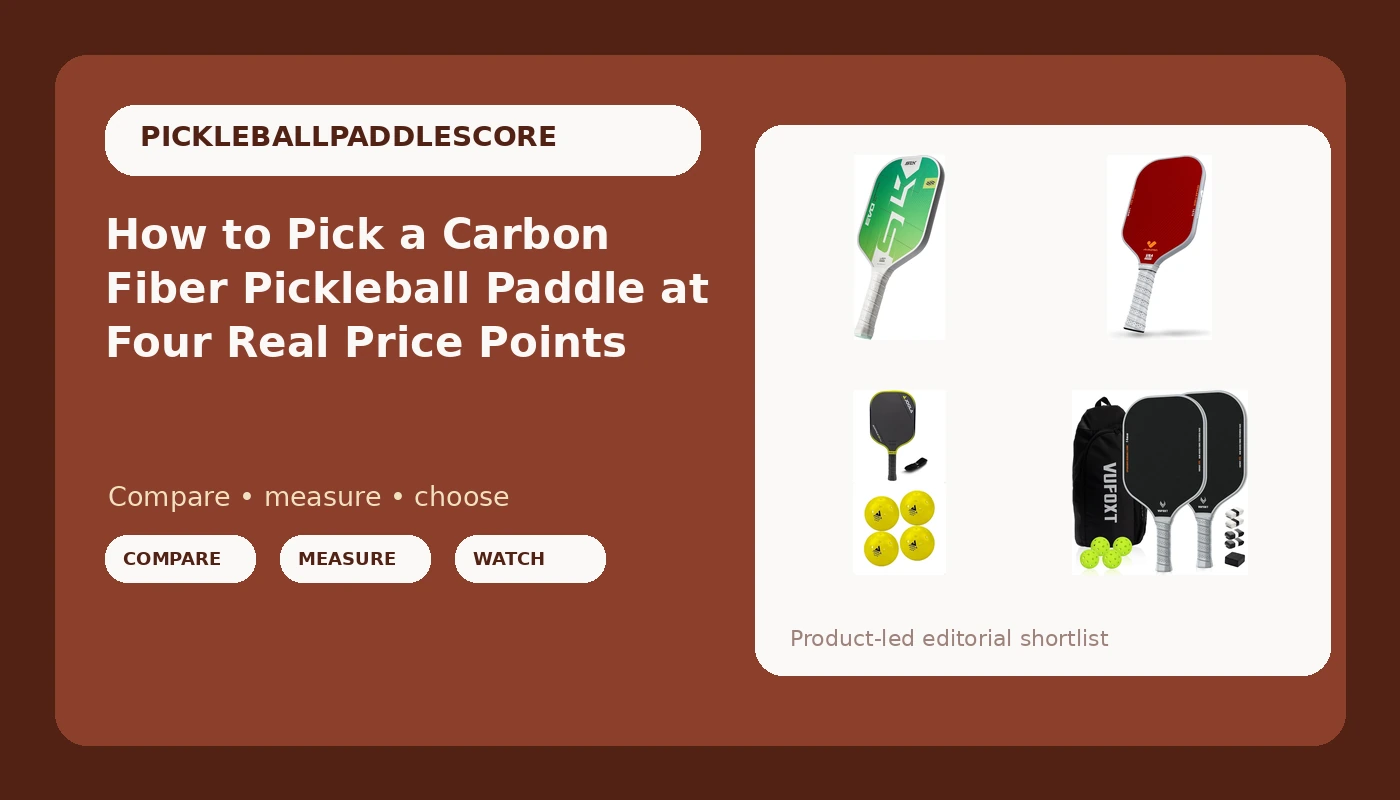
Most players I coach in Naples make their paddle decision backwards. They watch a highlight video, buy the model with a touring pro's name printed on it, then spend three months fighting a stiff face and a sweet spot they cannot find under pressure. A carbon fiber pickleball paddle is a sensible default for nearly every recreational player right now, but the ladder from a budget set to a premium wide body hides real differences: core thickness, face texture, shape, edge construction, and what the thing looks like after six weeks of humid doubles at a club with 400 members.
This is not a ranking, and it is not a list of winners. It is an explanation of what changes as you move up that ladder, using four currently available paddles as fixed reference points. Read it in order and you should be able to name the rung you belong on before you spend anything.
Related: Thermoformed vs Non-Thermoformed Pickleball Paddles: What Actually Changes →
Quick answer
For most recreational players, the right carbon fiber pickleball paddle is a mid-weight frame with a polymer honeycomb core between 14mm and 16mm, a textured carbon fiber face, a wide enough body to forgive a late contact point, and a grip you can replace yourself. If you are outfitting a household, a brand new player, or a club loaner bin, a paddle set makes far more sense than one premium frame. If you already know your preferred shape and swing weight, a wide body paddle built around a larger sweet spot is a reasonable step up, as long as you are honest about whether your hands are quick enough for the extra real estate.
Four useful options
| Model | Best fit | What stands out |
|---|---|---|
| Pickleball Paddles Set of 2/4, USAPA Approved Carbon Fiber Surface Pickle Ball Set | New players, families, club loaner bins | Sold as a set of two or four, USAPA approved, carbon fiber surface over a 14mm polypropylene honeycomb core |
| Selkirk Sport SLK Evo Carbon Fiber Pickleball Paddles | Players stepping up from a starter paddle | Carbon fiber construction from an established paddle brand, positioned around control and power |
| JOJOLEMON Carbon Fiber Pickleball Paddle with 16mm Shark Power Polymer Core | Players chasing spin and a consistent response | 16mm Shark Power polymer core paired with a carbon fiber face, built around spin and consistency |
| JOOLA Anna Bright Scorpeus 3S 14mm Pickleball Paddle | Players who want a wide body and a larger sweet spot | Propulsion core, charged carbon surface, wide body shape, NFC chip, USAPA certified, bundled with a JOOLA Primo ball |
The starting point: Pickleball Paddles Set of 2/4, USAPA Approved Carbon Fiber Surface Pickle Ball Set
The trade off with a set is consistency. When four paddles come out of one box, they are built to one spec rather than tuned around a single player, and the grips and edge guards are usually the first things to show wear. That is fine when the goal is getting a family on court this weekend or keeping loaners in the club bin. It is not the paddle you buy to chase a rating. If you are buying for yourself and you already play twice a week, treat this as a starting point and plan on a second purchase in a year, not as a long term frame.
The middle step: Selkirk Sport SLK Evo Carbon Fiber Pickleball Paddles
This is the band where I send most of my adult members, and it is the band where the marketing gets loudest. What you are actually buying at this level is a face that holds texture longer than a bargain paddle, a core that does not turn to mush, and a brand with a warranty process you can navigate. What you are not buying is a magic jump in your third shot drop. The honest test of any mid price paddle is whether it still feels like itself after three months of doubles, and that is a question no product page answers.
The spin focused option: JOJOLEMON Carbon Fiber Pickleball Paddle with 16mm Shark Power Polymer Core
Thicker cores are the least understood spec in the sport. A 16mm core generally gives you a softer, more forgiving hit with a wider effective sweet spot, at the cost of some of the pop that a 14mm core delivers on drives. Players who win with dinks, resets, and patience usually prefer the thicker build. Players who win with hand speed and put away power often do not. Notice that the claim on this listing is spin and consistency, which is a technique dependent promise: the face texture helps, but the wrist does the work.
The premium wide body: JOOLA Anna Bright Scorpeus 3S 14mm Pickleball Paddle
Wide body paddles are the most forgiving shape for the recreational majority, because the extra width moves the sweet spot further from your hand and covers a late contact. The cost is swing weight and reach in the transition zone. A 14mm core in a wide body is a deliberate compromise: more face area than a standard shape, with a thinner core that keeps some pop. The signature model markup is real, and it is the thing I argue with members about most. You are paying for the shape, the core construction, and the name. Two of those three are worth money.
Prices and availability may change. Product images, names, and retailer links are matched to verified listings. No current price, rating, stock status, or measured result is stated here without current evidence.
What core thickness actually changes
Core thickness is the single spec that most reliably predicts how a paddle will feel in your hand, and it is the one buyers skim past. The common range runs from about 13mm to 16mm. Thinner cores compress less on contact, which returns energy faster: more pop on drives and serves, a crisper sound, and a smaller area where the ball comes off cleanly. Thicker cores compress more, which absorbs energy and spreads the response across a wider area. You lose some free power and gain forgiveness, touch, and control on soft games.
That trade is not a quality judgment. It is a style match. The 14mm cores in the starter set and the premium wide body here sit on the livelier end. The 16mm core in the JOJOLEMON paddle sits on the control end. A player who blocks well and dinks patiently will usually be better served by the thicker core, and a player who drives from the baseline and crashes the kitchen will usually prefer the thinner one.
Face material, texture, and where spin really comes from
Carbon fiber is the face material everyone asks about, and it earns its place: it is stiff, light, and takes texture well. But the face is only part of the spin story. What generates spin at contact is the friction between the face and the ball, and that depends on how the surface was finished, how much grit remains after a month of play, and how you swing. Peel ply and grit finishes start aggressive and wear toward smooth. That is why a paddle that spins beautifully in week one can feel ordinary by week eight.
I tell members the same thing every season: spin is roughly 30 percent paddle and 70 percent technique. I can put more rotation on a ball with a club loaner than most players manage with a premium frame, because the low to high path and the contact point do the work. Buy a textured carbon face, yes. Then spend the money you saved on a lesson.
How to decide in five steps
- Name your level honestly. Under a year of play, a set or a mid price carbon paddle covers everything you need.
- Pick your core by how you win points. Soft game and resets point toward 16mm, drives and hand speed point toward 14mm.
- Check the shape against your reach. Wide body for forgiveness and a larger sweet spot, standard or elongated if you already cover the court well.
- Confirm the listing says USAPA approved if you play sanctioned events, and confirm it before you buy, not after the paddle arrives.
- Plan for the consumables. Grips, edge guards, and face texture wear out long before the core does.
Practical guidance before you click buy
- Budget for a replacement grip in the first year, especially in humid climates where tape breaks down fast.
- Treat any spin number on a product page as a marketing claim until the same player swings two paddles side by side.
- Skip the signature model unless you specifically want its shape, core, or face construction.
- Buy the set if more than one person in the house plays, and buy a single paddle if only you do.
- Demo before you commit if your club or a local shop offers it. Thirty minutes of doubles tells you more than any spec sheet.
Which option should you choose?
Choose the Pickleball Paddles Set of 2/4, USAPA Approved Carbon Fiber Surface Pickle Ball Set when you are outfitting a beginner, a family, or a club loaner bin and you need several playable paddles at once. Choose the Selkirk Sport SLK Evo Carbon Fiber Pickleball Paddles when you have outgrown a starter paddle and want a carbon face from an established brand at the middle of the market. Choose the JOJOLEMON Carbon Fiber Pickleball Paddle with 16mm Shark Power Polymer Core when your game is built on dinks, resets, and consistency rather than power. Choose the JOOLA Anna Bright Scorpeus 3S 14mm Pickleball Paddle when you want a wide body with a larger sweet spot and you are willing to pay for the premium tier.
One caveat applies to all four. Nothing here is a substitute for knowing your own game, and no product page can tell you whether a given paddle suits your hands. The specs I have described come from the listings themselves, not from a controlled comparison, and a paddle that feels perfect in a store can feel slow in a fifth game of the night.
The bottom line
The carbon fiber pickleball paddle market rewards patience and punishes hype. Core thickness and face construction are the two specs that actually predict how a paddle plays, and they are both printed on the listing if you know to look. Buy the thickness that matches how you win points, buy the shape that matches your reach, and buy at the lowest rung that gives you a face that will still have texture in three months. That is the decision, and it is a shorter one than the marketing suggests.