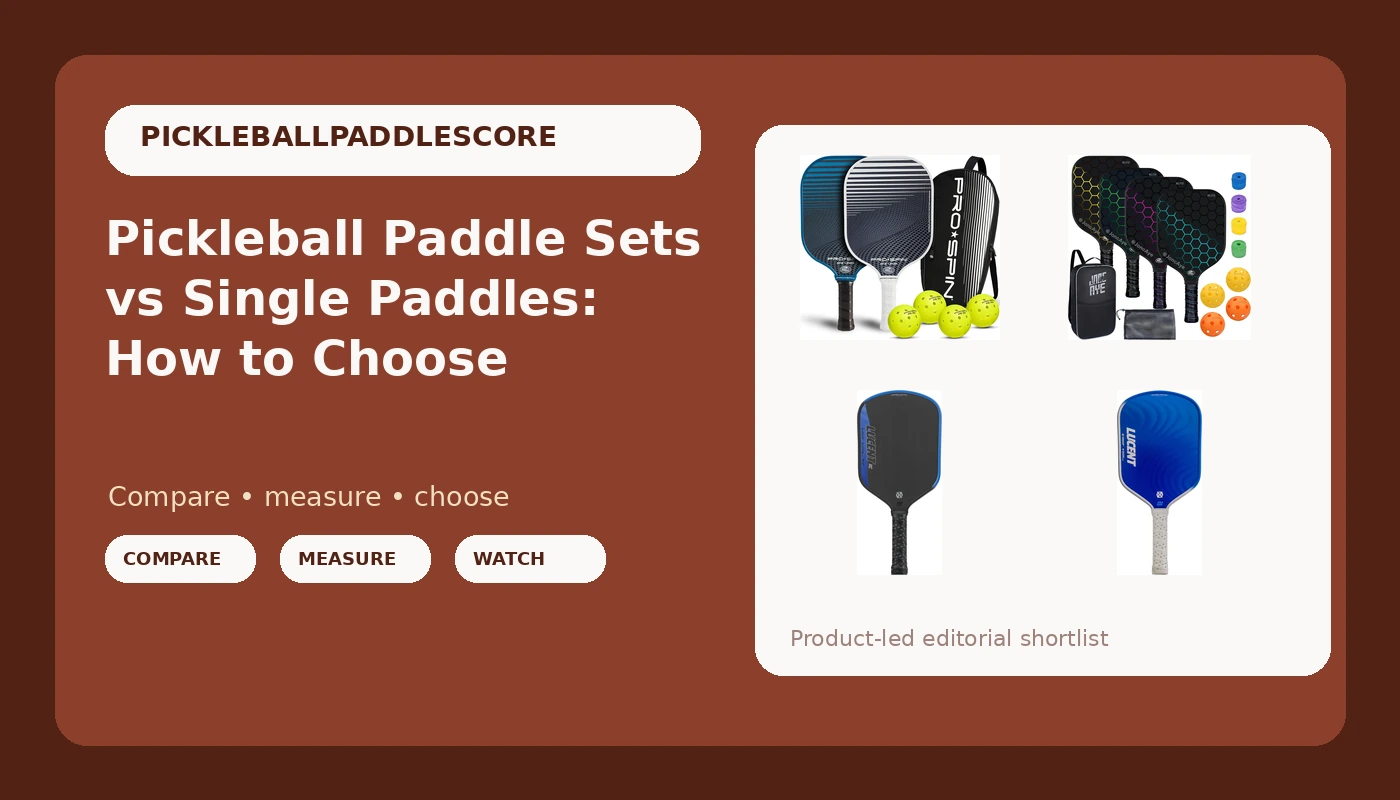
Buying for one player is a different problem from outfitting a driveway court, a family, or a club loaner bin. That is why a search for pickleball paddle sets and a search for a single performance paddle end up in completely different places, even though both finish at the same checkout page. The four listings in this comparison cover both jobs: two multi-paddle sets that arrive with the extras you need to start playing, and two single Onix Lucent paddles for a player who already knows what they like and wants to change how the face feels. What follows is the reasoning behind each option, not a ranking.
Related: How to Choose the Right Pickleball Paddle Grip Size →
Quick answer
If you are buying for more than one player, or starting from zero, a set is the practical purchase. The PRO-SPIN set of 2 pairs carbon fiber faced paddles with indoor and outdoor balls and a bag, and the JoncAye listing is sold as a set of 4 or 2 with fiberglass faces and a USAPA approval claim on the page. If you are buying for one player who already owns a paddle, the two Onix Lucent listings are the single-paddle path, offered with composite and raw carbon fiber face options. Because the two Lucent entries share a name, confirm the exact face option and configuration on the listing before you order.
4 useful options
| Model | Best fit | What stands out |
|---|---|---|
| PRO-SPIN Carbon Fiber Pickleball Paddles Set of 2 | Families and new players who want everything in one box | Carbon fiber faced paddles in a two-paddle set that includes indoor and outdoor balls and a carry bag |
| JoncAye Pickleball Paddles Set of 4 or 2 Fiberglass Rackets | Households, groups, and club loaner bins | Sold in a 4 or 2 configuration with fiberglass faces and a USAPA approval claim on the listing |
| Onix Lucent Pickleball Paddle, Composite and Raw Carbon Fiber Face Options | One player replacing a worn paddle | A single-paddle listing offered with composite and raw carbon fiber face options |
| Onix Lucent Pickleball Paddle, Composite and Raw Carbon Fiber Face Options | One player comparing the two Lucent listings | A second Lucent listing under the same name, so face option and configuration must be checked on the page |
Both Onix Lucent rows describe separate listings with the same product name. That is not a mistake in the table; it is the reason you read the listing page instead of the title alone.
Two-paddle starter set: PRO-SPIN Carbon Fiber Pickleball Paddles Set of 2 | Lightweight Pickleball Set with Indoor/Outdoor Balls and Bag, Durable Pickle Ball Paddle Gift for Men, Women & Families
The trade-off with any set is that the manufacturer builds to a price for the whole package, not to a single player's preferences. Grip circumference is usually one middle size, so a player with very large or very small hands may want to add overgrip. The included balls are a convenience, not a commitment: once you know which ball your group prefers, you will buy those separately. For a household testing the sport, or a pair of friends who play twice a week, that package logic is exactly right. For someone who plays four or five sessions a week, the paddles in a set are the part you will outgrow first.
Group set: JoncAye Pickleball Paddles Set of 4 or 2 Fiberglass Rackets USAPA Approved
Fiberglass faces and carbon fiber faces are not a quality ranking, they are a preference split. Fiberglass tends to feel livelier and rewards a shorter, punchier swing; carbon fiber faces are generally associated with a softer, more controlled response and with grit textures that help players who generate spin with technique. If four people in your family are learning together, fiberglass is a friendly place to start because the ball comes off the face with less effort. The one thing to verify yourself is the approval claim: any manufacturer can print USAPA on a box, so check the model against USA Pickleball's published approved paddle list if you play in sanctioned events or a league that requires it.
Single-paddle listing: Onix Lucent Pickleball Paddle, Composite and Raw Carbon Fiber Face Options
When you buy a single paddle, the details buried in the listing are the whole purchase: face material, weight, grip circumference, and core thickness. Those four numbers decide whether a paddle suits a 55-year-old recreational player who wants a big sweet spot or a former tennis player who swings long and hard. Composite and raw carbon fiber faces behave differently enough that a demo session is worth the drive if your club has one. If you cannot demo, read the listing carefully and treat the face option as the first filter, not an afterthought.
Second single-paddle listing: Onix Lucent Pickleball Paddle, Composite and Raw Carbon Fiber Face Options
Two listings with the same name is common when a paddle line is sold in multiple configurations. Practically, that means the two Lucent entries here may differ in the face option, in weight, or in what is bundled, and the only reliable way to tell them apart is to open each page and read the option selector. This is the same discipline that protects you from buying an unapproved paddle by accident: the name on the box is marketing, the specification on the listing is the product.
Prices and availability may change. Product images, names, and retailer links are matched to verified listings. No current price, rating, stock status, or measured result is stated here without current evidence.
What a set actually buys you
A set is a packaging decision before it is a paddle decision. Manufacturers choose a face material, a core, and a grip size that will work acceptably for the widest range of buyers, then add balls and a bag so the purchase feels complete. That is genuinely useful when two or four people are starting at once, because the alternative is four separate decisions with four separate price points.
The cost of that convenience is personalization. Set paddles rarely come in multiple grip sizes, and the weight is usually a middle-of-the-road figure that suits most casual players and no particular competitive player. If you play twice a month on a driveway court, that compromise costs you nothing. If you play in a league, you will want a paddle chosen for your hand and your swing, and the set will become the spare that lives in the car.
Face material, core, and the numbers that actually matter
Face material changes feel more than any specification on the box. Composite faces are the traditional construction and tend to play with a predictable, slightly firmer response. Raw carbon fiber faces are associated with a textured surface and a more controlled, softer feel, which suits players who generate spin with their hands rather than with a fast swing. Fiberglass, used in the JoncAye listing, is the liveliest of the three and asks the least of a beginner's swing.
Core thickness sits behind those choices. A thicker core generally produces a softer, slower response with a more forgiving sweet spot; a thinner core feels crisper and rewards clean contact. Sweet spot size matters more than raw power for most recreational players, because a ball hit off center loses more than it gains from a hotter face. That is the honest reason a mid-price paddle with a large sweet spot beats a stiff, powerful paddle for the majority of club players.
Then decide in this order:
- Count how many players you are actually buying for, and whether anyone else will use the paddle.
- Decide whether you need accessories in the box or already own balls and a bag.
- Choose a face material that matches your swing: fiberglass for easy depth, composite for a traditional feel, raw carbon fiber for control and texture.
- Confirm the specifics on the listing page: face option, weight, grip circumference, core thickness, and any approval claim you intend to rely on.
- Set a budget band and let durability decide between similar paddles, since edge guards and face texture are what fail first.
Practical guidance
- Buy for the player you are today, not the player you plan to become in a year.
- If you are outfitting a group, a set of 4 is cheaper per player than four separate paddles, but only if all four people actually play.
- Treat approval claims as something to verify against USA Pickleball's published list if your league requires approved equipment.
- Plan on replacing grip tape once or twice a season in humid climates, and budget for it.
- Check the return window before ordering a single paddle you have never held, because feel is not something a listing can convey.
Which option should you choose?
Choose the PRO-SPIN Carbon Fiber Pickleball Paddles Set of 2 when two players are starting together and you want carbon fiber faces, balls, and a bag in a single purchase. Choose the JoncAye Pickleball Paddles Set of 4 or 2 Fiberglass Rackets USAPA Approved when you need to put three or four players on court, or when you want a livelier fiberglass face and a set sized to your group. Choose the Onix Lucent Pickleball Paddle, Composite and Raw Carbon Fiber Face Options single-paddle listings when one player is upgrading, and compare the two Lucent pages side by side to see which face option and configuration each one offers.
One caveat worth stating plainly: nothing here substitutes for holding a paddle. Face material and core thickness describe tendencies, not guarantees, and two paddles with identical specifications can feel different in the hand. If your club runs a demo program, use it before you spend on a single paddle.
The bottom line
The four options split cleanly by job. Multi-paddle sets handle the "we need to get playing this weekend" problem, with the PRO-SPIN set of 2 covering a pair and the JoncAye listing covering a larger group in fiberglass. Single paddles handle the "I know what I want and I want it in my hand" problem, and the two Onix Lucent listings are the place to start that search, provided you read each page carefully because they share a name. Buy the set if the players are new and the paddles will be shared. Buy the single paddle if the player is committed and the details on the listing match how they actually swing.