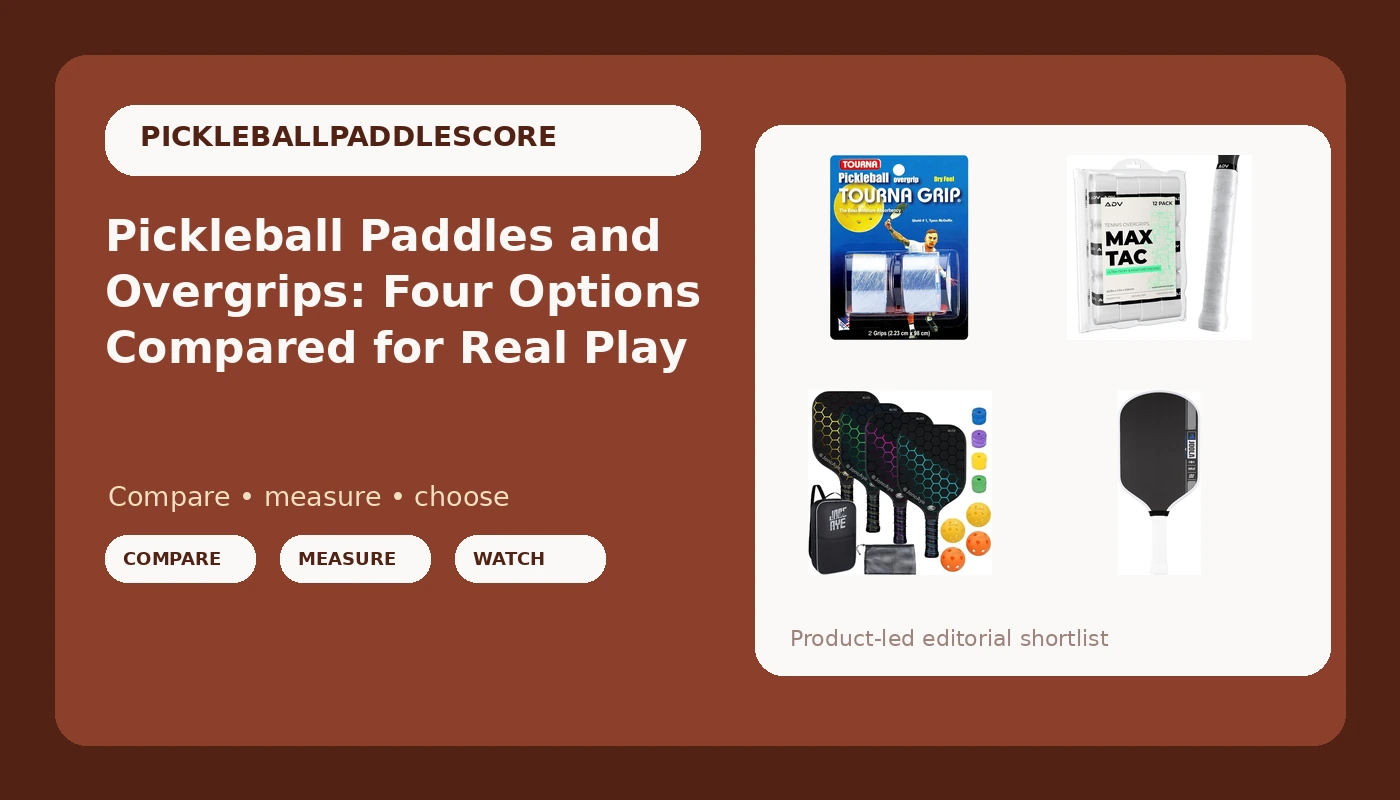
I run the demo program at a 400 member club in Naples, Florida, and I have logged more than 60 paddles in five years. That log has a column for spin rate, a column for sweet spot size, and a third column that matters more than either one: what the paddle looks like after three months of doubles. So when four products land on my bench at the same time, I do not ask which one is best. I ask which one earns a permanent spot in the bag and which one is a marketing story with a handle glued on.
Shopping for pickleball paddles and overgrips is really two decisions wearing one hat. The paddle sets the ceiling on your game. The overgrip decides whether you can hold the thing in July. Most players get the first decision roughly right, ignore the second completely, and then blame the paddle when their hand slips on a third shot drop.
Related: Pickleball Paddle Core Thickness Explained 13mm Vs 16mm
Here is the short version. If you already own a paddle you like, the cheapest real upgrade on this page is a fresh overgrip, and the ADV MaxTac 12 pack is what I hand out at the club. If you are buying a paddle, the JOOLA Pro IV is the serious option for a player who already has control, and the JoncAye set is what I point a family toward when they want rackets that work and nothing more.
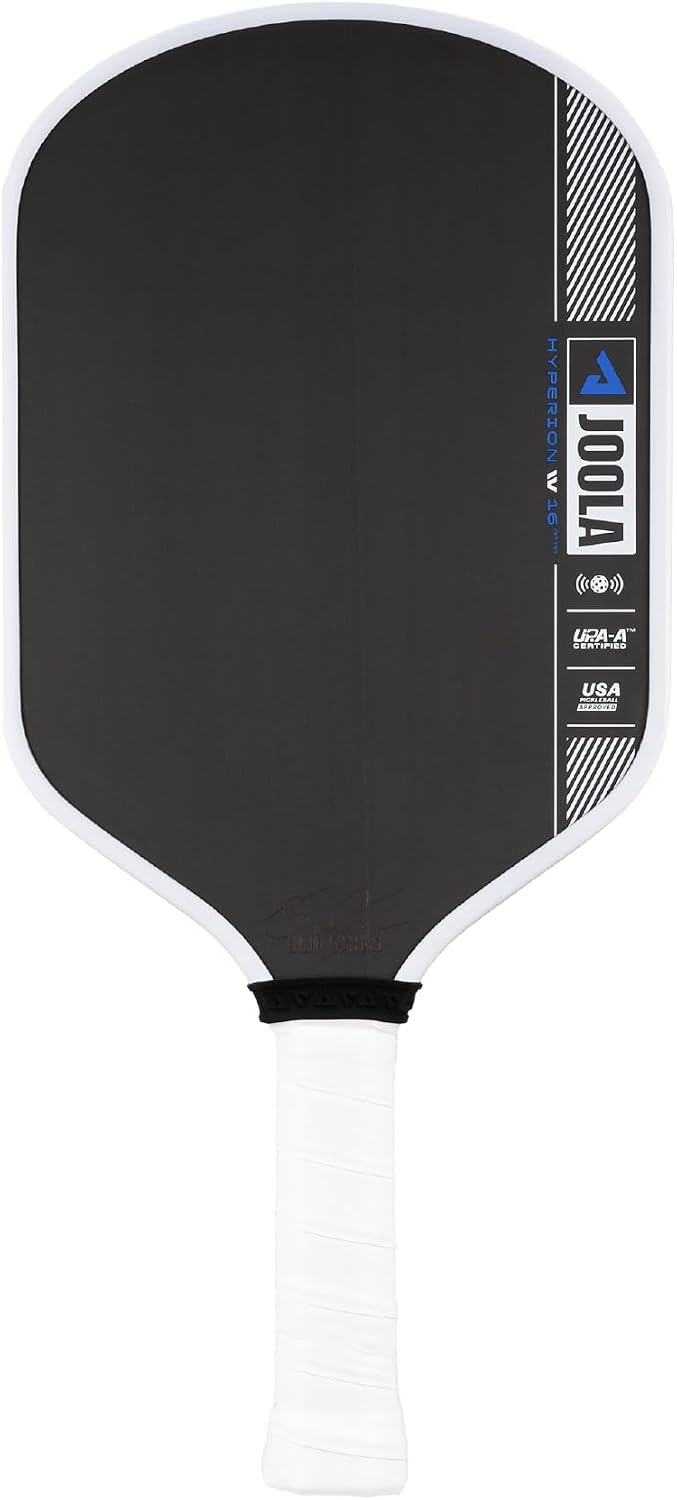
JOOLA Pro IV Pickleball Paddles
Raw carbon fiber surface, four shapes and two core thicknesses to match a real game, UPA-A and USAP approved
Pro level spend, and the power punishes anyone who has not sorted out control first
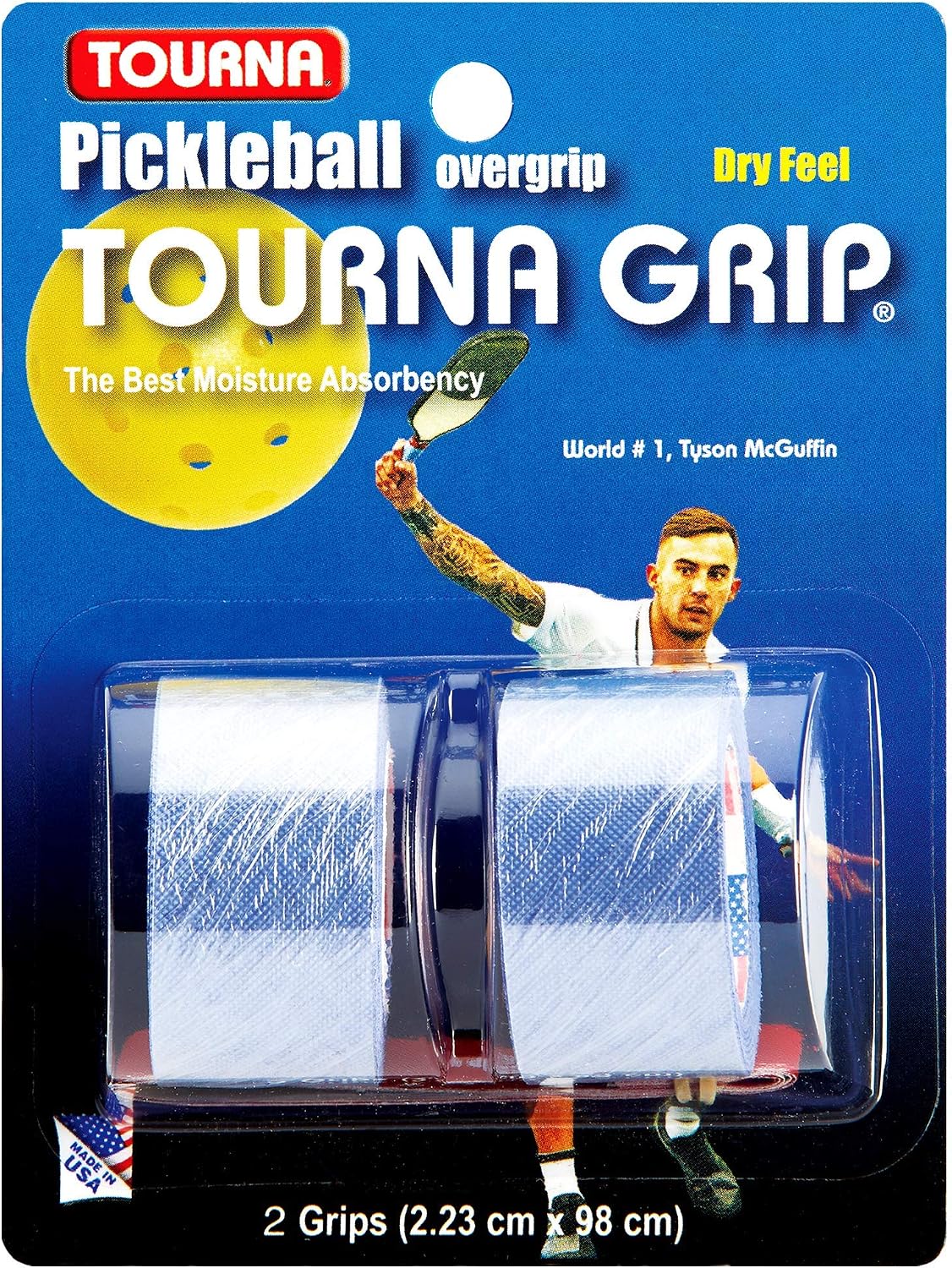
Pickleball Tourna Grip Overgrip for Pickleball Paddles
Thin, absorbent, the classic fix for a slick handle in humidity
Wears through faster than a tacky wrap and needs rewrapping more often
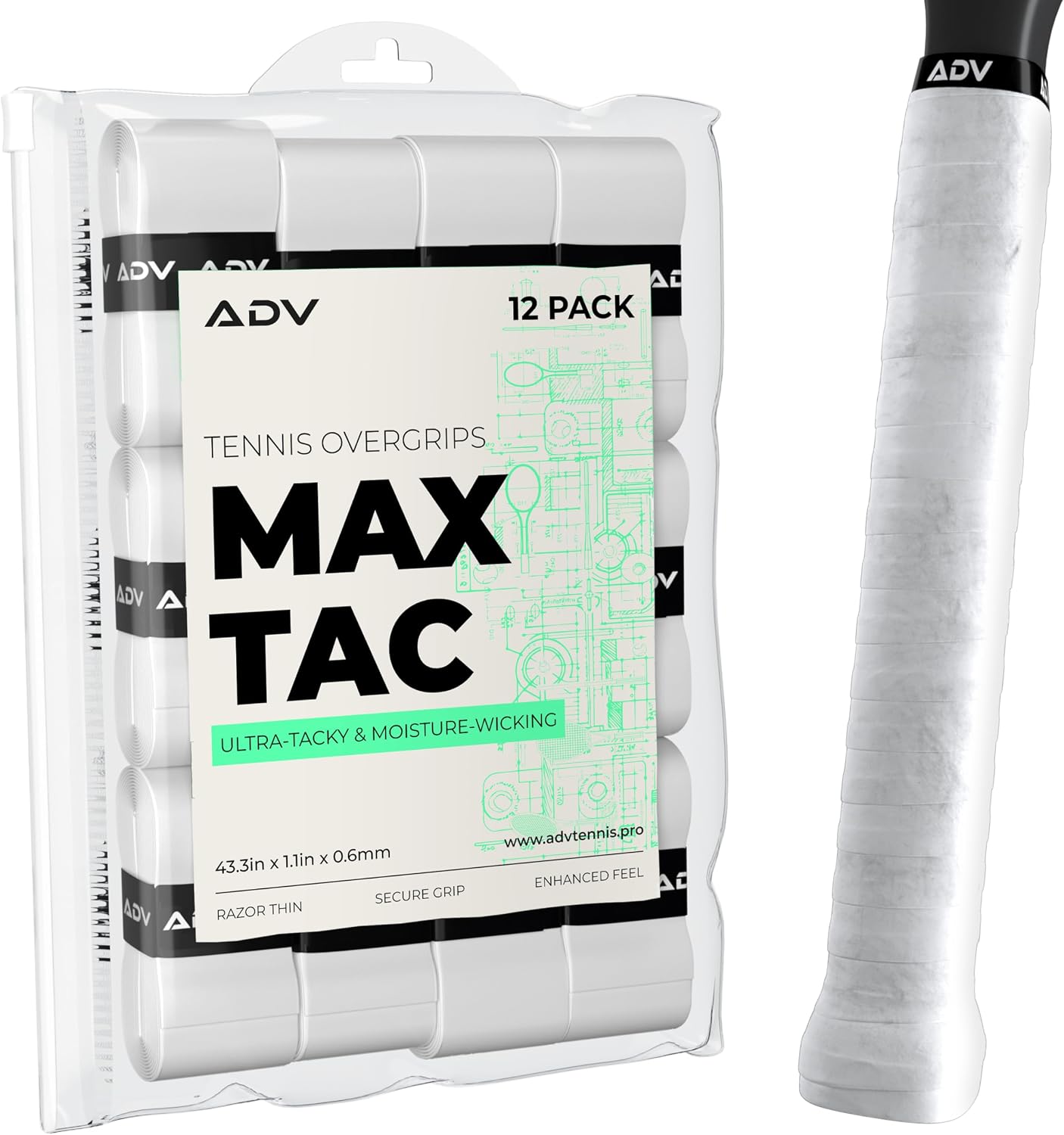
ADV MaxTac Tennis Overgrip, Tacky Moisture-Wicking Grip (White, 12-Pack)
Tacky, moisture wicking, and a 12 pack covers a full season of doubles
The tack can feel sticky for dry hands, and it is sold as a tennis grip
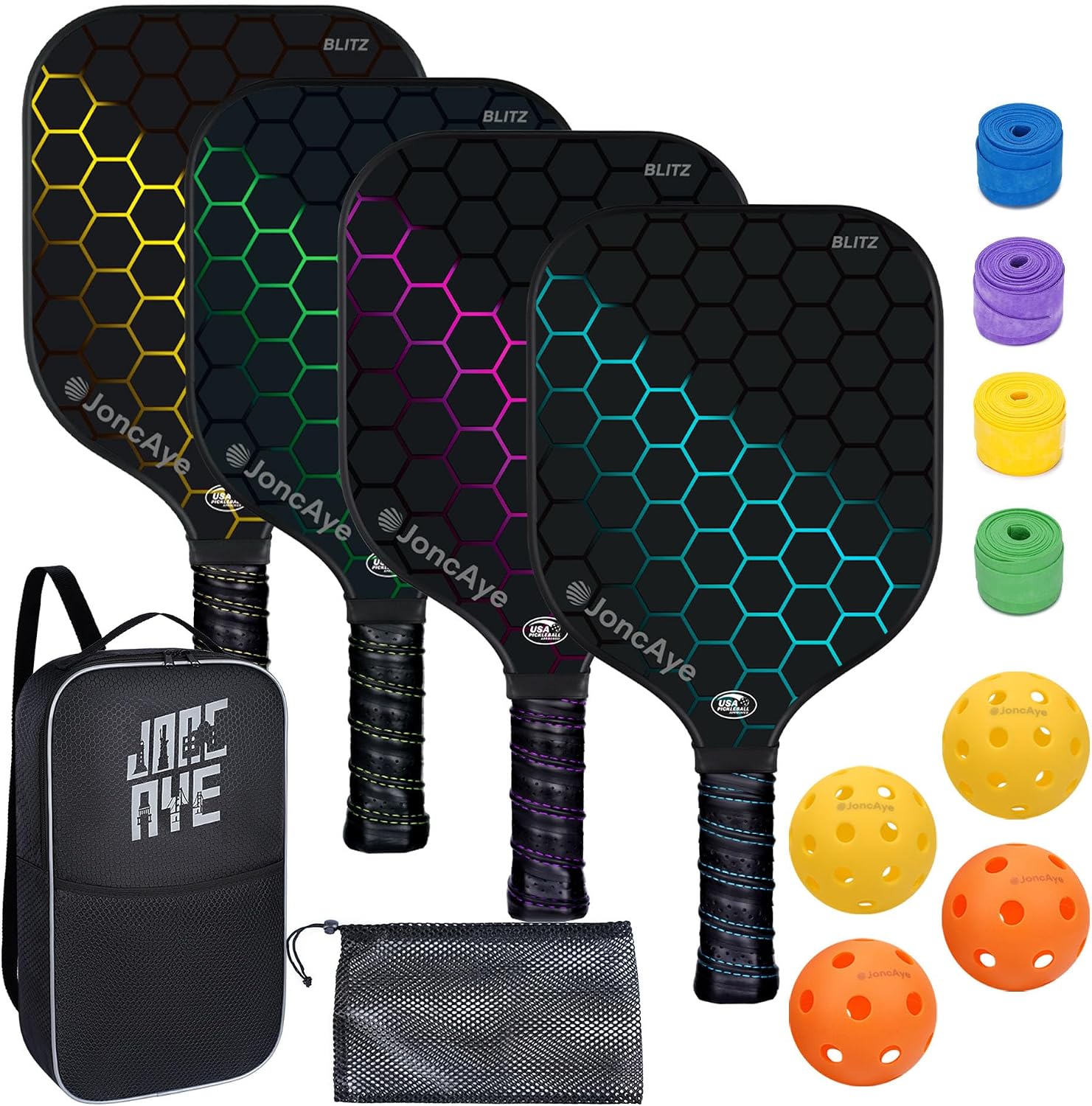
JoncAye Pickleball Paddles Set of 4 or 2 Fiberglass Rackets USAPA Approved
Sold as a set, USAPA approved, and fiberglass is forgiving in new hands
No core or shape choice, and the stock grip and face texture will not hold up like carbon
Prices and availability were captured from Amazon Creators API and may change.
How I compare gear at the club
Every paddle that comes through the demo program gets the same treatment. Same player, both paddles, alternating games, because a paddle that feels fast in your hand for one session tells you almost nothing about whether it will still be in your bag in October. I want to know what happens in week six, after the face has seen a few hundred balls and the edge guard has met the court a few times.
Three things go in the log. First, sweet spot. I care more about how big the usable face is than how hard the ball comes off the middle, because nine out of ten players at my club lose more points to off center contact than to a lack of power. Second, face texture and how long it lasts. A grit face that is dead by week five is a failed product no matter how it plays on day one. Third, the grip, because a slick handle turns a good paddle into a bad one faster than any other single factor.
That third item is why two overgrips are in this comparison at all. On paper it looks like filler sitting next to two paddles. It is not. In Florida humidity, the stock grip on nearly every paddle becomes a liability by the second month, and an inexpensive wrap fixes it in about four minutes. I have watched more players lose confidence to a slipping handle than to a dead core.
So the table above mixes price brackets on purpose. The paddle is the big decision. The overgrip is the small decision that changes how the big one feels.
The JOOLA Pro IV: what raw carbon fiber actually changes
The JOOLA Pro IV Pickleball Paddles are the real thing, and the reason is in the first three words of the description: raw carbon fiber surface. Raw carbon gives you a textured face that grips the ball rather than a painted grit layer that sits on top of it. Painted grit wears off. On the paddles I have logged over three months, the painted faces are the ones that come back smooth in the middle while the raw carbon faces still have something for the ball to bite.
The other thing this paddle gets right is choice. It comes in Perseus, Hyperion, Scorpeus and Magnus shapes, in 14mm and 16mm cores, wide or elongated. That is not a marketing menu, it is a real fork in the road. A 16mm core is the forgiving, controllable option and it is what I would hand a 55 year old recreational player who wants to keep the ball in the court. A 14mm core is faster off the face and rewards a player who already generates their own pace. An elongated shape buys you reach and a higher sweet spot. A wide shape buys you forgiveness on off center hits.
Then there is approval. This one is listed as UPA-A and USAP approved, and I check that every single time, because a paddle that shows up at a tournament without the right approval is a wasted entry fee and a bad afternoon. This is one of my standing complaints about the market: plenty of paddles claim approval and arrive without it.
The trade off is honest. This is pro level money for a paddle, and the Tech Flex Power and Propulsion Core design is built to add pop. If your problem is that you hit the ball long, more pop is not your answer. Sweet spot size beats raw power for nine out of ten players, and a player without control will lose more points with this paddle than they gain.
The JoncAye set: who this is actually for
The JoncAye Pickleball Paddles Set of 4 or 2 Fiberglass Rackets USAPA Approved solves a completely different problem, and I want to be fair to it. This is a set, not a single paddle. For a household where two people are curious, or a family that wants four rackets in the car for the weekend, a set is the correct answer and a single premium paddle is not.
Fiberglass is the honest beginner face material. It flexes more than carbon, it is more forgiving on mishits, and it costs less to make, which is why it shows up in sets. What you give up is spin retention. Fiberglass faces do not hold texture the way a raw carbon face does, so the ball will not check up the same way on a cut third shot. For a player still learning to keep a rally going, that is not the limiting factor. Their technique is.
The set is listed as USAPA approved, which is the check that matters for recreational league play at most clubs. It does not come in different core thicknesses and it does not come in different shapes, so there is nothing to fit to your game. The stock grip will also need replacing before long, and that is not a knock on this set specifically, it is true of nearly every paddle that ships with a factory wrap. Budget for a pack of overgrips in the same order.
My honest read: this is the paddle I recommend to the player who says they are not sure they will stick with it. It gets you on a court for less than a block of lessons, and the lessons are what will actually make you better.
Overgrips do more work than any paddle upgrade
I keep a box of overgrips in my coaching bag the way a tennis pro keeps a towel. If you take one thing from this comparison, take this: replacing a factory grip is the highest return, lowest cost change you can make to your setup, and it does not care what paddle you play.
The reason is simple physics of the hand. A grip that rotates in your palm forces you to squeeze harder to stabilize the paddle, and squeezing kills your wrist release on dinks and resets. You feel it as a paddle that suddenly seems slow. The paddle is not slow. Your hand is working too hard.
Tourna Grip versus ADV MaxTac: two overgrips, two jobs
The Pickleball Tourna Grip Overgrip for Pickleball Paddles is the classic. It is thin, it is absorbent, and because it wraps thin you keep the feel of the bevels on the handle, which matters for players who adjust their grip between shots. Tourna has been the standard in the sweaty hand world for a long time for a reason.
The trade off is durability. Thin absorbent wraps are the ones that go first in Florida, and you will rewrap more often. That is not a defect, it is the nature of the material. If you sweat heavily and you want maximum feel, this is the pick and you buy them in quantity.
The ADV MaxTac Tennis Overgrip, Tacky Moisture-Wicking Grip (White, 12-Pack) is the other personality. It is tacky, it wicks moisture, and it comes as a 12 pack in white, which means you can rewrap every couple of weeks for a whole season without thinking about it. The tack gives you a locked in feel without a death grip. For dry hands, tack beats absorbency, and for players who grip the paddle hard on drives, the tacky surface does more work than the thin one.
Two notes on it. First, yes, it is sold as a tennis overgrip. The grip on a handle is the grip on a handle, and the wrap is the same job. My rule about not comparing to tennis is about rackets, where the physics of the string bed and the frame are genuinely different from a paddle face. Grip tape does not have that problem. Second, the tack is not for everyone. If your hands run dry, a tacky wrap can feel sticky in a way that some players dislike. That is a preference, not a flaw.
If I had to name one item on this page that belongs in every bag, it is this 12 pack. It is the thing I hand to a player who tells me their paddle feels different than it did in the spring.
The trade-offs I will not paper over
The JOOLA Pro IV is a better paddle than the JoncAye set. It should be, and it costs more. But better is not the same as better for you. If you are three months into the sport and still learning to hit a consistent third shot, the extra spin and power will mostly produce longer misses. Spend the difference on lessons and a demo session first.
The JoncAye set will not keep up with a serious player. The face texture will fade, the grip will need replacing, and there is no way to tune the core or the shape to your game. What it will do is get four people on a court this weekend, and that is a real job.
The two overgrips are not interchangeable. Tourna for feel and sweat. ADV MaxTac for tack and a long supply. Buying the wrong one for your hands is a small mistake, but it is a mistake players make for years because nobody tells them there is a choice.
And the thing I will keep saying until it stops being true: most players would improve more from four lessons than from any paddle on this page. The gear arms race in this sport is real, and the paddle is not usually the bottleneck.
How I would spend the money
If you own a paddle you like and your hand slips, buy overgrips. Start with the ADV MaxTac 12 pack if you want tack and a season long supply, or the Tourna Grip if you want thin feel and heavy sweat management. Rewrap the day the handle starts to feel polished.
If you need a paddle and you play three or more times a week, the JOOLA Pro IV is the one that will still be in your bag next year. Pick a 16mm core and a wide shape if you want forgiveness, and a 14mm elongated if you already control your own power.
If you are buying for a household, a beginner, or a player who is not sure this sport is going to stick, the JoncAye set is the sensible buy. Add a pack of overgrips with it and you have a setup that works for a long time.
What I am testing next
The next thing on my bench is the durability question I care most about: how face texture holds up across a full season at the 3.5 level, where the ball is struck hard enough to matter and the players are not replacing gear every month. I will keep logging it, because the paddle that feels amazing for one session and dead after six weeks is still a failed product, no matter how good the first session was.