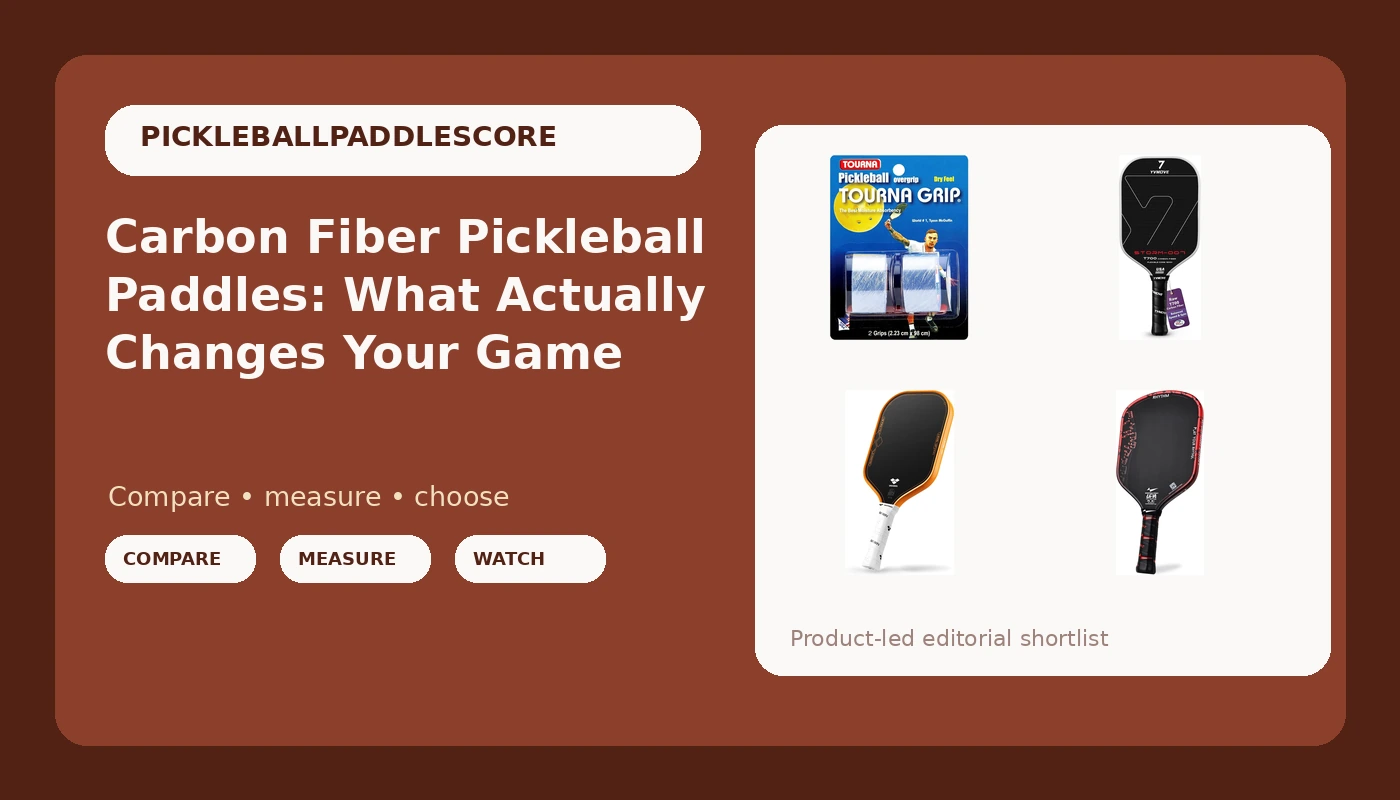
Carbon fiber pickleball paddles own the demo bin at my club, and the questions I get about them are always the same. Does the face material actually change anything, or is it marketing with a nicer name? The honest answer is that face material and core thickness change how a paddle feels and how long it keeps feeling that way, while a good deal of what gets printed on the throat is decoration. The hard part for a recreational player is the vocabulary. Raw carbon fiber, T700, Kevlar, 16mm, thermoformed, USAPA approved, UPA-A approved. Four of those words can show up on the same paddle, and none of them tells you whether it suits your game.
The four items below cover the realistic spread of a mid-price paddle decision: a precision-first hybrid, a Kevlar-faced 16mm build, a raw carbon model aimed at intermediate players, and the overgrip that fixes the most common handle complaint in Florida humidity. A spec sheet will not settle the argument for you, but it can narrow four paddles down to the one worth demoing first.
Related: How Core Thickness Changes Your Sweet Spot →
Quick answer
If control is the priority, start with the Warping Point Rhythm 16MM Pickleball Paddle, because its 16mm hybrid build, T700 carbon fiber face and MaxCell honeycomb core are all aimed at precision rather than raw pop, and it carries UPA-A approval. If you specifically want a Kevlar-faced 16mm paddle, the YVmove 16mm Kevlar T700 Carbon Fiber Pickleball Paddle is the direct comparison and it is USAPA approved. Intermediate players stepping up from a starter paddle should look at the Pickleball Paddles Raw Carbon Fiber model, which is also USAPA approved and described for intermediate play. Whichever paddle you end up with, the Pickleball Tourna Grip Overgrip is the simplest fix for a handle that slips, shines, or has worn through.
Four useful options
| Model | Best fit | What stands out |
|---|---|---|
| Warping Point Rhythm 16MM Pickleball Paddle, T700 Carbon Fiber, MaxCell Honeycomb Core, Hybrid Paddle for Precision Control, UPA-A Approved | Players who want control before power | 16mm hybrid profile with a T700 carbon fiber face and MaxCell honeycomb core, UPA-A approved |
| YVmove 16mm Kevlar T700 Carbon Fiber Pickleball Paddle, USAPA Approved | Players who want a Kevlar-faced 16mm option | Kevlar and T700 carbon fiber face on a 16mm paddle, USAPA approved |
| Pickleball Paddles Raw Carbon Fiber USAPA Approved for Intermediate | Intermediate players moving up from a starter paddle | Raw carbon fiber face, USAPA approved, positioned for intermediate play |
| Pickleball Tourna Grip Overgrip for Pickleball Paddles | Anyone whose handle slips or wears out | Overgrip made for pickleball paddle handles |
Precision hybrid: Warping Point Rhythm 16MM Pickleball Paddle, T700 Carbon Fiber, MaxCell Honeycomb Core, Hybrid Paddle for Precision Control, UPA-A Approved
Here is the trade-off you are accepting. A 16mm core almost always plays softer and more forgiving than a thinner core, and softer means less free pop on your drives and serves. That is the deal most recreational players should take, because a bigger effective sweet spot wins more points at the 3.5 level than extra pace does. The hybrid shape is the compromise inside the compromise: more reach than a wide body, more forgiveness than a full elongated frame. If your priority is control and you want one paddle to learn on for a full season, this is the description that matches.
Kevlar and carbon: YVmove 16mm Kevlar T700 Carbon Fiber Pickleball Paddle, USAPA Approved
Kevlar in a paddle face is not a magic spin button. What it signals is a different layup choice inside the same 16mm envelope, and layup affects how the face feels and how the paddle responds on off-center contact. Two paddles can share a core thickness and play nothing alike, which is exactly why "16mm" alone should never decide your purchase. The practical reason to shortlist this one is the approval label: if your club ladder or your local tournament runs off the USAPA list, a USAPA approved paddle is the safer buy than one approved by a different body. Verify the listing against the current published list before you order, because approval status is not permanent.
Intermediate step-up: Pickleball Paddles Raw Carbon Fiber USAPA Approved for Intermediate
"Intermediate" is the most useful word on this listing, and also the one to think hardest about. A player two months into the sport usually needs forgiveness and a big sweet spot more than a raw carbon face, because the face texture does nothing for you until you are consistently finding the center of the paddle. A player who has already learned to reset, dink and block is a different case, and that is the player this paddle is described for. The raw carbon fiber face is the durable-face story rather than the instant-spin story, and USAPA approval keeps your tournament options open.
Handle upgrade: Pickleball Tourna Grip Overgrip for Pickleball Paddles
I have watched more players blame a paddle for a problem that lived in the handle. In Florida humidity, a factory grip goes slick long before a core goes dead, and a slick handle forces you to squeeze, which tightens your arm and costs you control on dinks and resets. An overgrip also nudges handle circumference up a little, which is useful if the standard size feels thin in your hand. Swap grips before you swap paddles, and give any new paddle at least three sessions before you decide it is wrong for you.
Prices and availability may change. Product images, names, and retailer links are matched to verified listings. No current price, rating, stock status, or measured result is stated here without current evidence.
What carbon fiber actually changes
Face material is about how the hitting surface behaves and how long it behaves that way. Fiberglass faces are the traditional budget choice and they play fine, but they tend to feel softer and lose their texture sooner. Raw carbon fiber faces are built with a textured surface rather than a sprayed-on grit coat, and the pattern I see across the paddles I handle is that a textured carbon face holds its feel longer than a coating that sits on top of the surface. That is a durability argument more than a spin argument.
T700 is a carbon fiber specification, not a score. It tells you what grade of fiber went into the layup, not how powerful or how spin friendly the finished paddle is. A T700 face on a 16mm core will feel very different from a T700 face on a thin core, because the core does most of the work on feel.
Thermoforming is the other word worth knowing. A thermoformed paddle bonds the core and faces with heat and pressure instead of relying on a glued stack, and the ones I have handled tend to feel more solid and more consistent across the face. It is the one recent manufacturing change that shows up in play, and it is spreading down the price range.
Spin is where most shoppers get lost. Face texture contributes, but the larger share comes from your technique: contact point, upward path, and how much of the ball you actually catch. A textured face rewards a player who already generates spin. It does very little for a player who hits flat.
Core thickness, shape, and approval labels
Core thickness drives the feel more than any face material. A 16mm core plays softer, absorbs more pace, and gives you a wider effective sweet spot, which is why both 16mm paddles above are described the way they are. Thinner cores, in the 13mm range, feel crisper and deliver more pop, at the cost of a smaller margin for error. If you are choosing between the two, choose the thicker core unless you already know you want more pace and can control it.
Shape is the next decision. A wide body gives the largest sweet spot and the shortest reach. An elongated frame gives you reach and leverage on serve, with a smaller sweet spot and more twist on off-center hits. A hybrid sits in between, which is why it is the shape I suggest most often to players who do not have a strong preference yet.
Approval labels are not interchangeable. USA Pickleball and UPA-A are separate bodies with separate lists, and a paddle approved by one is not automatically approved by the other. If you play sanctioned events, check the current published list the week you buy rather than assuming the badge on the throat is current. Approval status can change, and a listing can lag behind it.
- Decide whether you want control or pop before you look at any face material.
- Match core thickness to that answer: 16mm for forgiveness, thinner for pace.
- Pick a shape based on whether you need reach or a bigger sweet spot.
- Verify the approval label against the list used by the events you actually enter.
- Budget the handle as well as the paddle, since an overgrip is the cheapest way to change feel.
What to do before and after you buy
- Regrip first. A worn factory grip mimics the symptoms of a bad paddle.
- Give a new paddle three sessions before judging it, because your hand has to adjust.
- Demo a USAPA approved and a UPA-A approved paddle side by side if you play both club and sanctioned events.
- Choose face material for how long it holds up, not for an instant spin upgrade.
- Keep a second paddle if you play both a control game and a power game, rather than asking one paddle to do both.
- Write down what you liked after each demo session. Memory for feel fades within a week.
Which option should you choose?
Choose the Warping Point Rhythm 16MM Pickleball Paddle, T700 Carbon Fiber, MaxCell Honeycomb Core, Hybrid Paddle for Precision Control, UPA-A Approved when control is your priority and you want a 16mm hybrid whose description points at precision, with UPA-A approval. Choose the YVmove 16mm Kevlar T700 Carbon Fiber Pickleball Paddle, USAPA Approved when you want a 16mm paddle with a Kevlar and T700 face and you need USAPA approval. Choose the Pickleball Paddles Raw Carbon Fiber USAPA Approved for Intermediate when you are an intermediate player stepping up from a starter paddle and want a raw carbon face with USAPA approval. Add the Pickleball Tourna Grip Overgrip for Pickleball Paddles to any of them if your handle slips or your grip has gone shiny.
One caveat worth stating plainly: nothing here is a measured comparison. These are spec sheets, approval labels and descriptions, not lab numbers, and the same paddle behaves differently in different hands. Core density and face material mean very little until the same player swings two paddles back to back.
The bottom line
The paddle market rewards players who read carefully. Face material is mostly a durability and feel decision, core thickness is the decision that actually changes how you play, and approval labels are a tournament logistics question you should check before you order. For most recreational players the smartest sequence is simple: fix the grip, pick a 16mm core, choose a shape you can control, and verify the approval you need. The Warping Point Rhythm is the control-first hybrid to demo first, the YVmove is the Kevlar-faced USAPA approved alternative, the raw carbon intermediate model is the step-up for a developing player, and the Tourna Grip overgrip is the low-risk change that helps almost everyone.