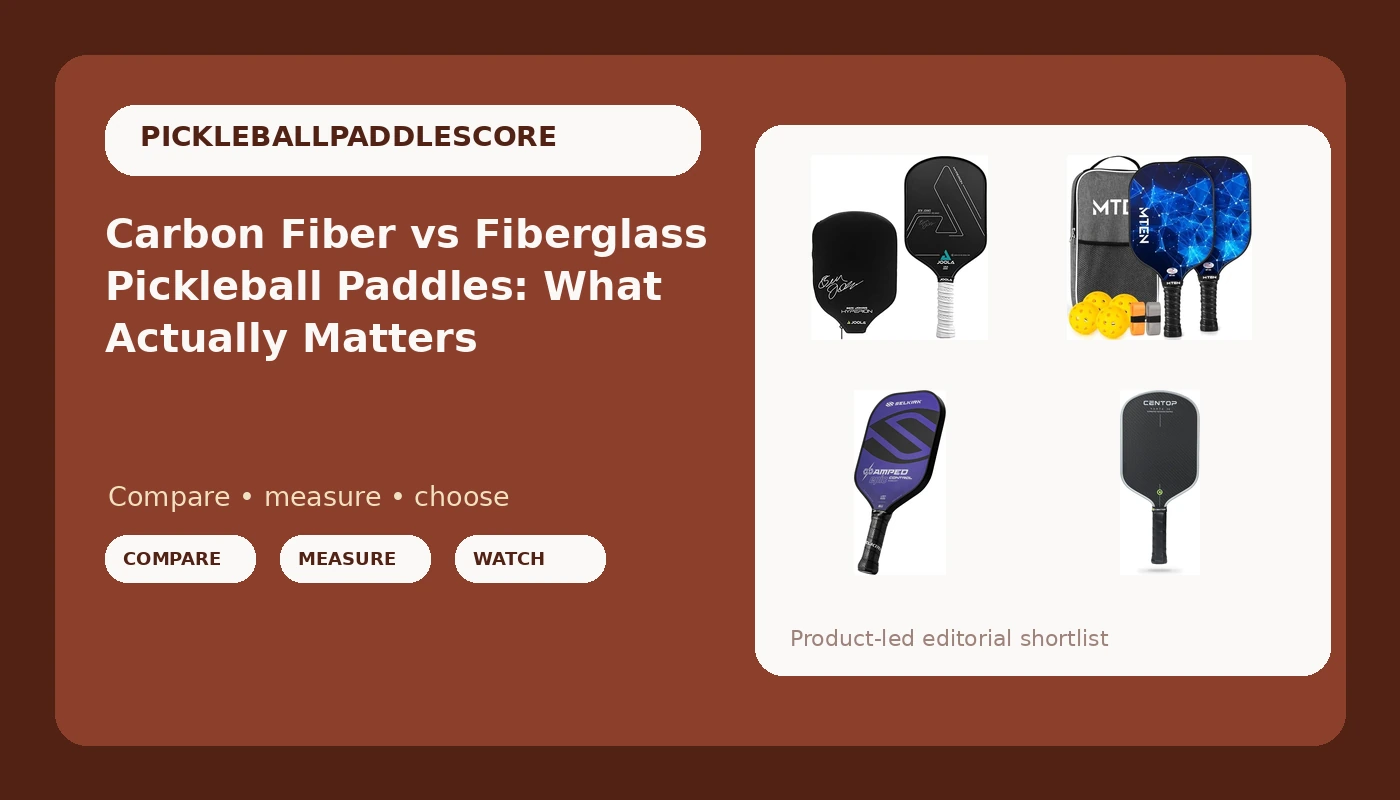
Two paddles can look almost identical on a product page and feel nothing alike in your hand. That is the trap behind the whole carbon fiber vs fiberglass pickleball paddles question. The material printed on the face tells you something, but it does not tell you whether the paddle suits your swing, your grip, or the way your club plays doubles on a Tuesday night. Most recreational players shopping right now are really choosing between four versions of the same decision: a thermoformed carbon build, a control-first fiberglass build, a spin-focused signature model, and a multi-paddle set that outfits a household or a loaner bin. This explainer walks through what each construction actually changes on the court, and where each of four real options fits.
Related: Paddle Core Thickness Explained: 13mm vs 16mm →
Quick answer
Face material is the headline, but construction and core are what you feel. Carbon fiber faces tend to play firmer and hold their texture longer. Fiberglass faces tend to flex a little more and feel softer on contact. Thermoforming, where the body is bonded under heat and pressure into one piece, is the biggest structural change of the last few years, and it now shows up well below the pro-model tier. A 16mm core plays more forgiving than a thinner core, which is why control-oriented paddles cluster there. If you want the modern unibody build, look at the CENTOP carbon model. If forgiveness matters more than pop, the Selkirk Amped Control. If spin and reach are the goal, the JOOLA Ben Johns Hyperion. If you are outfitting several players at once, the MTEN set.
Four useful options
| Model | Best fit | What stands out |
|---|---|---|
| CENTOP Carbon Fiber Pickleball Paddle: Thermoformed 16mm Full Foam Core | Players who want the modern thermoformed build without a signature-name markup | Carbon fiber face on a thermoformed body with a 16mm full foam core |
| Selkirk Sport Amped Control Pickleball Paddles | Fiberglass | 16mm X5 Core | Control-first players who want a soft, forgiving face | Fiberglass face paired with a 16mm X5 core |
| JOOLA Ben Johns Hyperion CFS Pickleball Paddle, Carbon Surface with High Grit & Spin, Elongated Handle, USAPA Approved Ben Johns Paddle | Players chasing spin and extra reach on the backhand side | High-grit carbon surface and an elongated handle |
| MTEN Pickleball Paddles Set of 2/4/1, USAPA Approved Fiberglass Rackets | Beginners, families, and club loaner stock | USAPA approved fiberglass paddles sold as multi-paddle sets |
The thermoformed carbon pick: CENTOP Carbon Fiber Pickleball Paddle: Thermoformed 16mm Full Foam Core
This is the option that reflects where the market has actually moved. A thermoformed body is bonded as one piece, so the face, core, and perimeter are not relying on a separate glued-on edge the way a traditional build does. The practical upside is a more consistent response across the face and less flex at the perimeter on off-center hits. The trade-off is feel: unibody paddles tend to play firmer with less dwell time, which some players love and others find harsh on dinks. A 16mm core softens that considerably compared with a thin core. If you have been reading about thermoforming and wondering whether it is worth paying for, this is the least expensive way to find out that is still a carbon-faced paddle.
The control-first pick: Selkirk Sport Amped Control Pickleball Paddles | Fiberglass | 16mm X5 Core
If your problem is that the ball keeps flying long on resets and third-shot drops, this is the profile to look at. Fiberglass flexes more than carbon, which gives you a slightly longer dwell on the face and a gentler rebound. Pair that with a 16mm core and you get a paddle that is more forgiving on contact point and less likely to punish a slightly late swing. The trade-off runs in the other direction: you give up some free power and some of the crisp feedback that carbon players like. Fiberglass face texture also tends to smooth out sooner than a textured carbon face, so if spin is your priority, weigh that against the comfort.
The spin and reach pick: JOOLA Ben Johns Hyperion CFS Pickleball Paddle, Carbon Surface with High Grit & Spin, Elongated Handle, USAPA Approved Ben Johns Paddle
This is the one to consider if your game already includes a heavy topspin drive or a two-handed backhand. The elongated handle gives your second hand somewhere to go, and the grit on the face is designed to grab the ball. Be honest about two things before you buy. First, spin is mostly technique; a gritty face rewards a player who already brushes the ball and does very little for a player who hits flat. Second, elongated shapes move the sweet spot up the face but tend to narrow it, so mishits toward the edge cost you more than they would on a wide-body control paddle. Signature models also carry a brand premium that has nothing to do with how the paddle plays for you.
The starter set pick: MTEN Pickleball Paddles Set of 2/4/1, USAPA Approved Fiberglass Rackets
Sets are built to a price, and that shows up in the details: simpler edge guards, plainer grips, and faces that will not hold texture as long as a dedicated carbon paddle. None of that matters much for a first season. What a set does well is remove the excuse. Two paddles mean a friend can play, four mean a family or a beginner clinic can play, and a single-paddle option lets you test the shape before committing to more. The honest advice is to treat a set as a starting point with a two-year horizon, not as the paddle you will still be swinging when your rating climbs.
Prices and availability may change. Product images, names, and retailer links are matched to verified listings. No current price, rating, stock status, or measured result is stated here without current evidence.
Thermoformed versus non-thermoformed, without the marketing
Thermoforming is a manufacturing method, not a feature you can feel through a screen. The face, core, and perimeter are heated and pressed into a single bonded unit rather than assembled with adhesive and a separate edge piece. Brands claim a stiffer, more powerful, more durable result, and structurally that reasoning holds up: fewer glue lines means fewer places for a paddle to soften or separate over time. What the marketing leaves out is the cost to feel. A unibody paddle transmits more vibration and gives you less dwell, which is exactly what some players want for punchy counters and exactly what others hate on soft games. The real question is not whether thermoforming is better. It is whether you want a firm, connected response or a soft, absorbing one. Answer that first, then let the construction label confirm your choice.
Core thickness, face texture, and sweet spot size
Core thickness is the number that quietly decides how a paddle plays. A 16mm core gives you more material behind the ball, which spreads the sweet spot, absorbs pace, and makes off-center contact less punishing. A thinner core gives you more pop and a faster rebound with a smaller effective window. For most recreational players, especially anyone over 50 or anyone playing mostly doubles, the thicker core is the better trade, because points at the kitchen line are won by control and patience rather than by a paddle that does the work for you.
Face texture is a wear item, not a permanent property. Molded texture, applied grit, and textured carbon all lose bite as they collect dirt, ball residue, and court grit, and how fast that happens depends on how often you play and where. Clean your face and your paddle will hold spin longer. Expect the sweet spot to shift as well: elongated shapes move it toward the top of the face, wide bodies keep it lower and broader, and the shape you choose should match where you actually make contact.
Before you buy anything, run this check:
- Decide whether you want power or dwell time. Be honest about which one your errors come from.
- Match core thickness to your level. Thicker for forgiveness, thinner for pop.
- Pick face material second. Carbon for firm feedback and texture life, fiberglass for softness and comfort.
- Check handle length and grip circumference against how you hold the paddle, especially if you use two hands.
- Set a budget band before you shop and stay inside it. The middle of the market is where the sensible builds live.
What holds up over a season of doubles
- Inspect the edge guard first. A guard that sits proud of the face will catch the ball on low resets, and a guard that is thin will chip.
- Treat face texture as consumable. If you play three or more times a week, expect the grit to fade long before the core does.
- Budget for grip tape. In humid climates, factory grips and cheap overgrips give out fast, and a re-grip is cheaper than a new paddle.
- Verify approval status yourself if you play sanctioned events. Approval lists are updated, and a listing can lag behind them.
- Demo before you commit when you can. A club demo program or a borrowed paddle for one session tells you more than any spec sheet.
Which option should you choose?
Choose the CENTOP Carbon Fiber Pickleball Paddle: Thermoformed 16mm Full Foam Core when you want to try the modern thermoformed carbon build without paying signature-model money. Choose the Selkirk Sport Amped Control Pickleball Paddles | Fiberglass | 16mm X5 Core when your errors come from overhitting and you want a softer, more forgiving face. Choose the JOOLA Ben Johns Hyperion CFS Pickleball Paddle, Carbon Surface with High Grit & Spin, Elongated Handle, USAPA Approved Ben Johns Paddle when you already generate spin with your hands and want reach and grip on the face. Choose the MTEN Pickleball Paddles Set of 2/4/1, USAPA Approved Fiberglass Rackets when you are equipping beginners, a household, or a club loaner bin rather than optimizing a single player.
One caveat applies to all four. Construction categories describe tendencies, not guarantees. Two paddles with the same face material and the same core thickness can still feel different because of shape, balance, and how the handle is built. Nothing here substitutes for holding the paddle, and no listing detail replaces the current spec sheet on the manufacturer's page.
The bottom line
The carbon fiber vs fiberglass pickleball paddles debate gets more attention than it deserves, because face material is only one of three variables that matter. Construction, meaning thermoformed or traditionally assembled, decides how firm and how consistent the paddle feels. Core thickness decides how forgiving the sweet spot is. Face material decides the texture and the softness of contact. Get those three in the right order for your game and you will land on a better paddle than someone who simply bought the most expensive one on the shelf. The CENTOP covers the modern build, the Selkirk covers control, the JOOLA covers spin and reach, and the MTEN covers everyone else at the table.