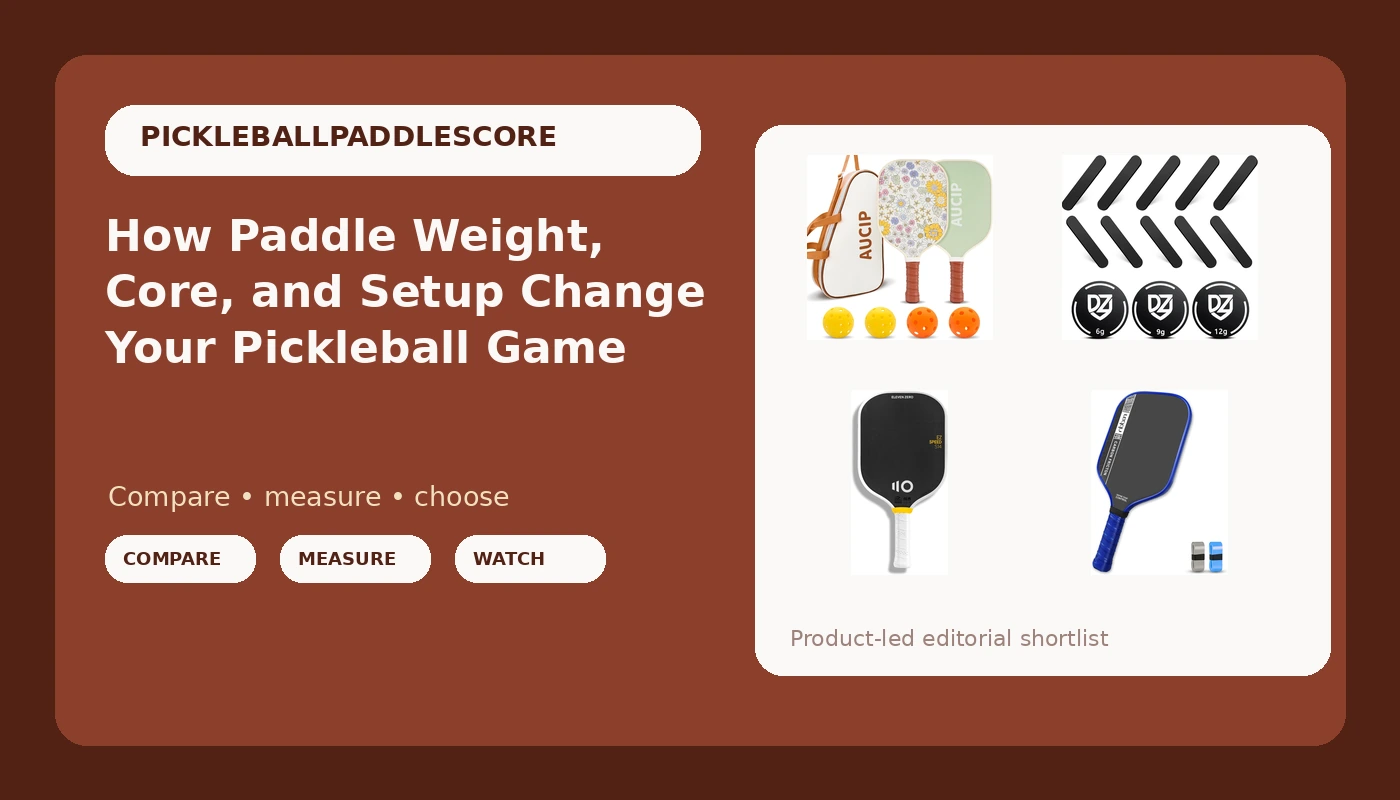
I coach at a club with 400 members in Naples, and the pattern repeats every season. A player buys a frame because a video promised pop, then spends three months fighting it at the kitchen line. The variables that actually decide whether you like a paddle are dull ones: pickleball paddle weight and core, face material, grip size, and whether the thing still plays well in month four. Nothing on the box tells you how those four line up with how you actually play.
This is not a ranking and it is not a hype list. It is a map of four listings that solve four different problems: a set for the household still deciding whether it likes the sport, a light carbon frame for the player who wants control without arm fatigue, a foam core build for the player chasing a bigger sweet spot, and a tungsten weight kit for the tinkerer who would rather adjust than replace.
Related: Core Thickness and Sweet Spot: What Actually Changes →
Quick answer
If you are outfitting a family or a pair of beginners, the fiberglass set covers everyone in one purchase and includes balls and a bag. If you play twice a week and want a light, control-first frame, the 7.6 oz carbon fiber paddle is the natural next step. If you want the foam core construction that has driven the real technology conversation in paddles, the EZ Speed model is offered in 16 mm or 14 mm. And if you want to change how a paddle you already own feels, the tungsten tape and end cap coins are the lowest-risk experiment here.
Notice what is missing from that list: any claim about which one wins. Core thickness and face material only mean something when the same player swings both options, so treat the summaries below as a starting point for your own demo, not a verdict.
Four useful options
| Model | Best fit | What stands out |
|---|---|---|
| Pickleball Paddles, USAPA Approved Set of 2/4, Polypropylene Honeycomb Core, Fiberglass | Beginners, families, club loaners | Sold as a 2 or 4 paddle set with balls and a bag, listed as USAPA approved |
| Pickleball Paddle Carbon Fiber Professional 16mm Graphite 7.6Oz Light | Players who want a light, control-first frame | 16 mm core, carbon fiber and graphite build, listed at 7.6 oz |
| EZ Speed Foam Core Pickleball Paddle 16mm or 14mm Carbon Fiber | Players curious about foam core | Foam core construction with a carbon fiber face, offered in two thicknesses |
| DZrudun Pickleball Paddle Weights, 10x3g Tungsten Tape + End Cap Coins | Anyone tuning a paddle they already own | Tungsten tape strips plus end cap coins in three weights |
The starter set: Pickleball Paddles, USAPA Approved Cute Pickleball Paddles Set of 2/4, Polypropylene Honeycomb Core, Fiberglass Pickleball Set with 2 or 4 Pickleball Rackets, 4 Balls, 1 Bag for Women
Here is the honest case for a set like this. Most people who quit pickleball in the first month do not quit because their paddle lacked spin. They quit because they never made it to the court, or because one person in the household had gear and the other did not. A bundle removes that friction in a single purchase, and it gives you a spare for the neighbor who wants to try a game before committing.
The trade-offs are real. A fiberglass face over a honeycomb core is built to a price, so expect a softer, more forgiving hit rather than a crisp one, and expect the face texture to be modest. A four-paddle box also means four paddles of the same grip circumference, which suits a family fine and suits a mixed group of adults less well. Buy a roll of grip tape with it. And if league or tournament play is on your calendar, verify the current approved list yourself before you show up, because approval listings change and a paddle that was fine last season is not automatically fine this one.
The light control frame: Pickleball Paddle Carbon Fiber Professional 16mm Graphite 7.6Oz Light
Weight is the spec most players ignore and the one their shoulder notices first. A frame listed at 7.6 oz is light enough that a player with a cranky elbow, or a player in the 70-and-over league, can hold the paddle up through a long doubles session without the last four points turning into pushing. That matters more than any power number on a product page.
The 16 mm core is the more forgiving of the two common thicknesses. More material behind the ball generally means a softer response and a larger area of the face that plays like the sweet spot, at the cost of some hand speed at the net. Carbon fiber and graphite faces are typically stiffer than fiberglass, which gives a crisper feel on blocks and resets, and they usually hold their surface texture longer, though that depends on how the manufacturer finishes the face. What you give up at this weight is plow-through: hard drives will not feel as heavy coming off the paddle, so you have to supply more of the pace yourself.
The foam core build: EZ Speed Foam Core Pickleball Paddle 16mm or 14mm Carbon Fiber
Foam core is where the paddle conversation has moved, and it is the one construction detail I would want a serious recreational player to understand before spending real money. The short version: instead of an open honeycomb, the core is filled or built with foam, which changes how energy comes back off the face and how the edges of the face behave on off-center contact. Whether that suits you depends on your game, not on the label. Players who block and reset all day tend to like the softer, more damped response. Players who drive and counter punch sometimes find it muted.
This listing hands you the choice between 16 mm and 14 mm, which is genuinely useful. The 16 mm will feel the softer and more stable of the two; the 14 mm will swing quicker and reward a player who generates their own pace. This is also the price tier where I tell members to think about month six rather than day one. Ask how the edge guard is finished and how the face texture is applied, because a paddle that plays beautifully fresh and goes dead by mid-summer is a failed purchase no matter how good the first session felt. There is no substitute for demoing it, and no product page can tell you which of the two thicknesses fits your swing.
The tuning kit: DZrudun Pickleball Paddle Weights,10x3g Tungsten Tape+End Cap Coins 6/9/12g
This is the item I get the most questions about at the club, and the one that saves the most money. Weight placement does different things depending on where you put it. Tape along the head adds plow-through and stability on blocks, and it also slows your hand speed. Coins in the end cap make a paddle more head-light, which can make a heavy frame feel quicker without changing its total mass much. Tungsten is dense, so a few grams go further than you expect, and the 3 g strips let you work in small steps instead of dumping half an ounce onto the head and wondering why your resets started flying.
Two cautions. First, add weight one strip at a time and play a full session before adding more, because the difference between right and too much is smaller than most players assume. Second, check your grip and your edge guard after adding anything, since tape that sits proud of the face or catches on the guard will hurt you more than the weight helps.
Prices and availability may change. Product images, names, and retailer links are matched to verified listings. No current price, rating, stock status, or measured result is stated here without current evidence.
Core thickness, face material, and weight: what each one changes
Three specs do most of the work, and all three are printed on the listings above.
Core thickness. The two common numbers are 16 mm and 14 mm. A thicker core puts more material behind the ball, which generally produces a softer response and a more forgiving face away from the center. A thinner core swings faster and gives a crisper, more direct feel, which suits players who generate their own pace and want the paddle out of the way at the net. Neither is better. They are different tools for different shots.
Core construction. Polypropylene honeycomb is the long-standing default and what the starter set uses. Foam core is the newer approach and the one the EZ Speed listing is built around. The practical difference is in feel and in how the face behaves on off-center contact, and the only way to know which you prefer is to hit both.
Face material. Fiberglass is softer, more forgiving, and usually cheaper. Carbon fiber and graphite are stiffer, which gives a crisper response and typically a face texture that lasts longer, though finish quality varies by manufacturer. Spin comes mostly from your hand and your contact point, not from the face alone, so do not buy a paddle for its grit rating.
Weight and balance. Static weight is what the scale says; swing weight is what your arm feels. A 7.6 oz frame and an 8.4 oz frame can swing very differently depending on where the mass sits. If you have arm trouble, start light and add weight rather than the other way around.
How to decide in one session
- Write down what actually goes wrong in your games. Pop-ups at the net, weak third shots, and a sore elbow point to three different paddles.
- Match core thickness to that problem. Control and stability point toward 16 mm; quick hands and self-generated pace point toward 14 mm.
- Match weight to your arm, not your ego. Lighter frames favor long doubles sessions and aging shoulders.
- Demo with the same partner and the same drill. A paddle that feels great in a warm-up rally can feel wrong in a real game.
- Verify the approved list and measure your grip before you buy, then plan on replacing the stock grip tape if your hands sweat.
Practical guidance before and after you buy
- Give any new paddle three full sessions before you judge it, because the first hour is mostly novelty.
- Add tuning weight in 3 g steps and stop as soon as the paddle feels heavy at the net.
- Budget for grip tape. Stock grips in Florida humidity are the first thing to go on almost every paddle.
- Keep one spare in your bag, especially if you are the person who brings new players to the court.
- Buy from a listing with a clear return window, because fit matters more than specs and you cannot demo a return policy.
Which option should you choose?
Choose the Pickleball Paddles, USAPA Approved Cute Pickleball Paddles Set of 2/4, Polypropylene Honeycomb Core, Fiberglass Pickleball Set with 2 or 4 Pickleball Rackets, 4 Balls, 1 Bag for Women when you are outfitting a household, a pair of beginners, or a set of loaners, and you would rather have everything in one box than optimize a single frame. Choose the Pickleball Paddle Carbon Fiber Professional 16mm Graphite 7.6Oz Light when you play regularly, want a control-first carbon frame, and your shoulder or elbow prefers a lighter paddle. Choose the EZ Speed Foam Core Pickleball Paddle 16mm or 14mm Carbon Fiber when you are ready to spend at the performance tier and want to choose your core thickness rather than accept a default. Choose the DZrudun Pickleball Paddle Weights,10x3g Tungsten Tape+End Cap Coins 6/9/12g when the paddle you already own is close to right and you want to adjust balance before spending on a replacement.
One caveat worth stating plainly: none of these listings tells you how the paddle will feel in your hand, and no article can. Weight, core, and face material narrow the field. They do not close it. If your club has a demo program, use it before you buy anything, and if it does not, ask whether the seller accepts returns.
The bottom line
Most players improve faster from a lesson than from a new frame, and that stays true at every price point. If you are going to spend anyway, spend on the spec that matches your actual problem: a set if you need gear for several people, a light carbon frame if your arm needs relief, a foam core build if you want to feel what the current construction conversation is about, and a few grams of tungsten if the paddle you own is already close. Match the paddle to your level and your arm, verify the approved list before league play, and judge every purchase at month six rather than on day one.