Every learn-to-play clinic I run in Naples starts at the same table of borrowed gear. Four paddles of wildly different weights, a bucket of balls, and one question I hear every single week: what do I buy first?
The honest answer is that a good pickleball paddle setup happens in two stages, and almost nobody separates them. Stage one is getting a workable, durable set into your hands for less than the cost of one tournament-level paddle. Stage two is tuning the weight and balance of the paddle you actually swing, once you know what you are missing.
Most beginners skip stage one, buy something expensive off an influencer video, and never reach stage two. That is backwards. You cannot tune a paddle you do not understand yet, and you cannot understand a paddle you have hit with four times.
So this guide covers both stages. What a beginner set should include, how to check it before the first game, and how to add weight with tungsten tape and end cap coins in a way you can reverse in five minutes if it does not work.
Why you should trust me
I have been coaching at a 400-member club since I picked up the sport in 2019, after playing tennis through college. I have demoed more than 60 paddles in five years and kept a log on every one of them: spin rate, sweet spot size, and how the face and edge guard hold up after three months of doubles. My feedback comes from both ends of the speed spectrum, the juniors I drill on Saturday mornings and the 70-and-over league that plays three mornings a week. Neither group cares what the marketing copy says.
My bias, up front. The paddle market is 90% marketing and 10% graphite, and most players would improve more from four lessons than from a $250 paddle. Sweet spot size beats raw power for nine out of ten players. A paddle that feels amazing for one session and dead after six weeks is a failed product no matter how it plays fresh. I do not sell paddles, I do not run a discount code, and nobody paid for a spot in this article.
How I picked and how I tested
For this guide I needed two things: a set a club can hand to four beginners without flinching, and a weighting kit that lets a player change one variable at a time.
My criteria for the set were cost per player, durability under loaner duty, and what comes in the box. A four-paddle set should be judged per person, not per box. Loaner duty means grips that survive sweat, faces that do not need babying, and a bag that gets carried by the handle instead of the zipper.
My criteria for the weighting kit were reversibility and increments. If a change cannot be undone, it is not tuning, it is a commitment. And if the pieces do not come in small, labeled steps, you cannot tell which change helped.
How I evaluate weight changes in general: same player, same drill, same partner, two sessions minimum before I believe anything. I do not publish numbers I cannot reproduce, and I do not trust a single session, because fatigue and timing fool you more often than gear does. One caveat before we start. Nothing here claims a wooden set plays like a composite paddle, and nothing here claims weight turns a beginner paddle into a pro model. It does not. What it does is let you change how a paddle feels for very little money.
What a beginner kit actually needs
If you are equipping a household, a clinic, or a group of friends, buy a set of four paddles instead of one. Beginners almost never show up alone, and the fastest way to kill a new player's interest is making them sit out because there is one paddle and four people.
The short list of what belongs in the bag: four paddles, several balls so a shanked shot does not end the game, a towel because your hands will be wet by the third game, and a bag that holds all of it. Grip comfort matters more than anything printed on the paddle face at this stage. A paddle that hurts your hand teaches you nothing.
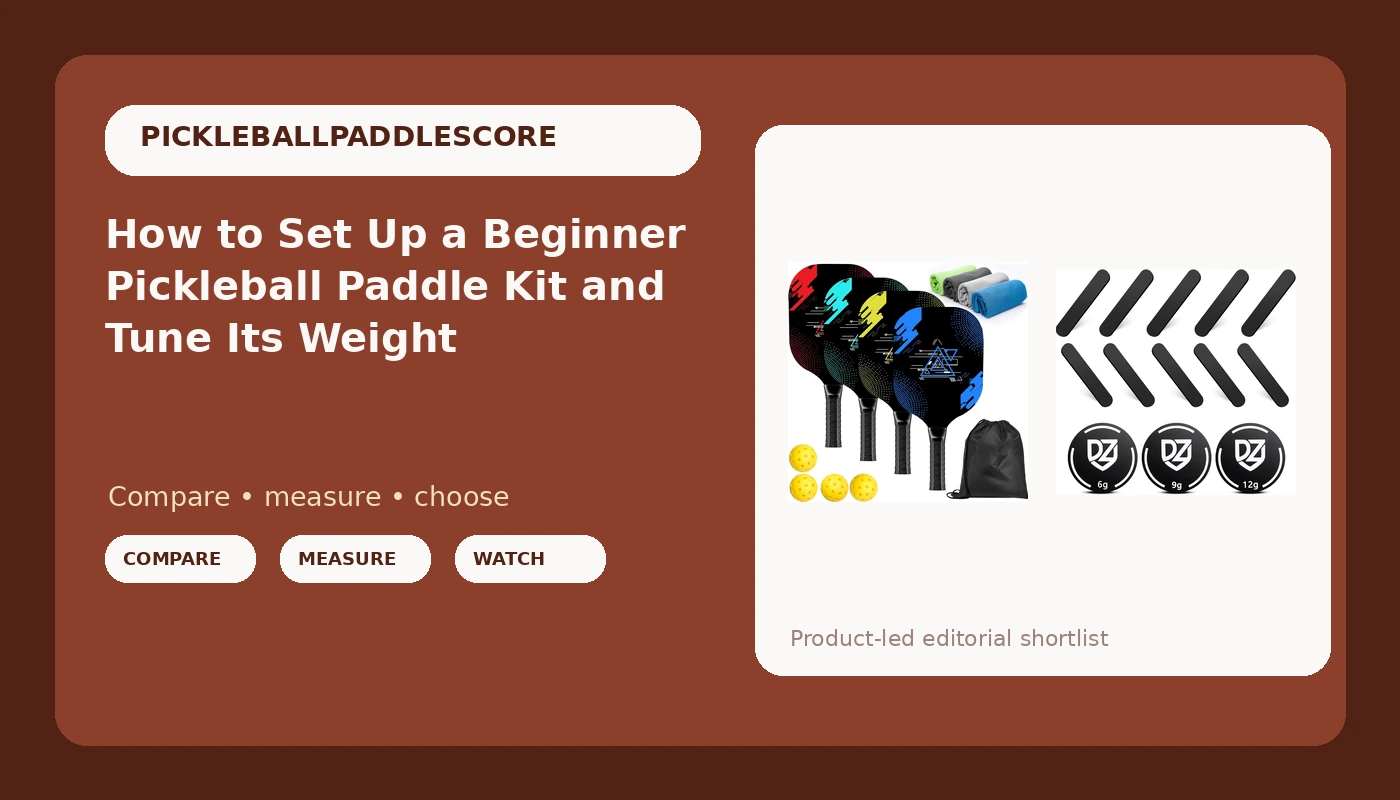
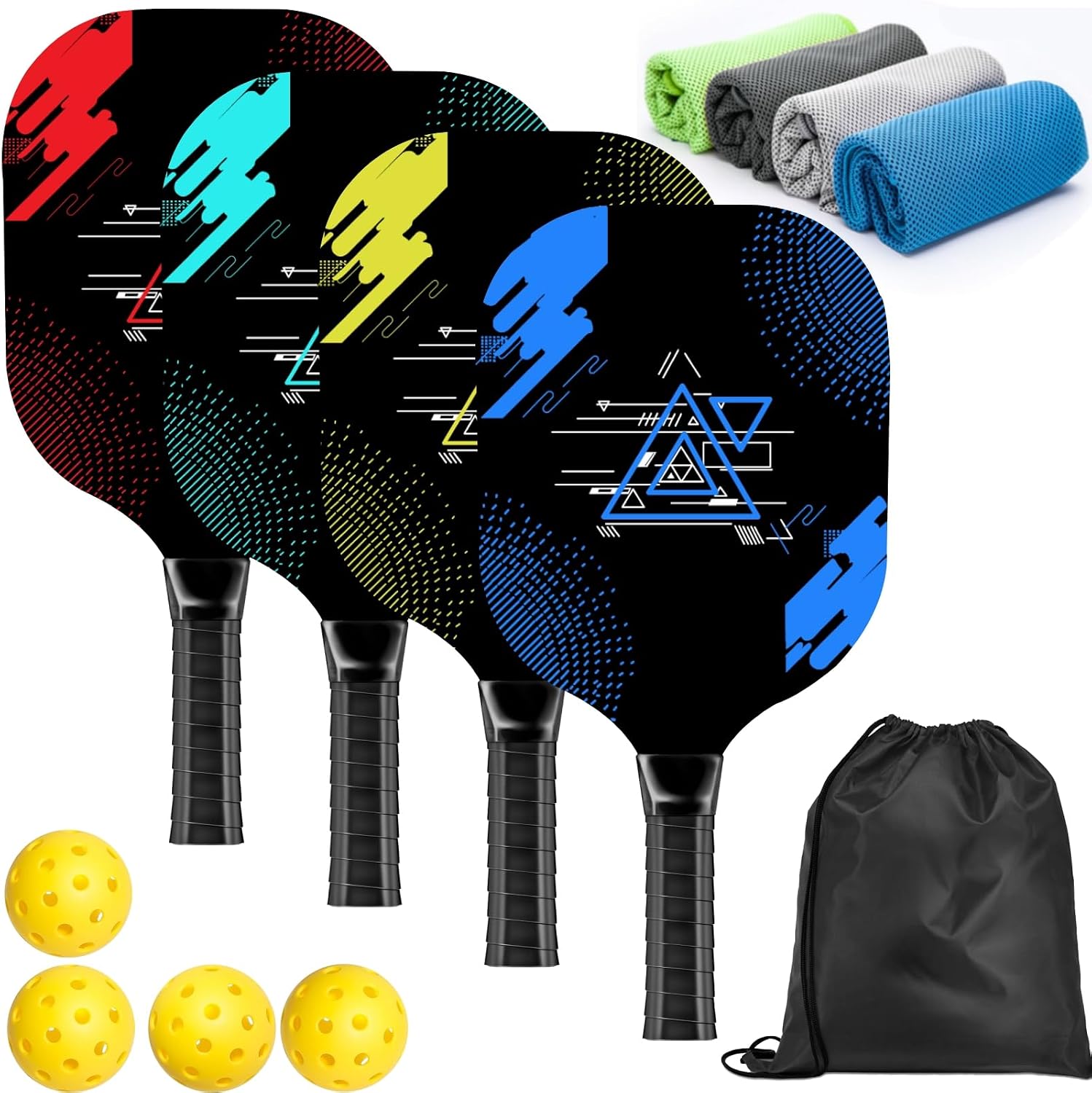
Beginner kit: Pickleball Paddles Set of 4, Wood Pickleball Set with Comfort Grip | 4 Cooling Towels, 4 Pickleball Balls & Carry Bag. Cushion Grip Wood Paddle Set for Men, Women, Beginners
 Visit on Amazon →
This is the box I would hand to a clinic group. Four wood paddles with cushion grips, four cooling towels, four balls, and a carry bag. Wood is the honest beginner material. It is heavier than a composite, which forces you to learn to use your shoulder and your feet instead of flicking your wrist at everything. The face has no grit, so spin has to come from technique, which is the right lesson anyway. The cooling towels are the part people underestimate. In Florida humidity your hands are slick by game three, and a dry grip is worth more than a stiffer face.
Flaws but not dealbreakers: wood is heavy, the sweet spot is smaller than a wide-body composite, and there is no face texture to help you grip the ball. The grip is a basic cushion wrap, not a premium overgrip, so plan on adding an overgrip if you sweat a lot. This is a beginner, family, and clinic set. Do not hand it to a 4.0 player and expect them to be happy.
Before the first game, check every paddle for a flat face, a tight edge guard, and a grip that does not spin on the handle. That two-minute inspection is the whole quality control process, and it catches the one bad paddle in the box.
Anyone buying for a household, a school program, or a trunk set for visitors will get their money's worth here.
How to add weight to a paddle
Adding weight is the cheapest real change in the sport, and it is the one most players do wrong. Two places matter, and they do different jobs.
Tape on the head at 3 and 9 o'clock widens the sweet spot and reduces how much the paddle twists on off-center hits. Tape at 12 o'clock adds swing weight and pop, but it slows your hands at the net. Weight in the handle or the end cap shifts the balance point toward your hand, which makes the paddle feel head-light and quicker without adding much to swing weight at all.
The direct answer for a beginner or a mid-level recreational player: start with a single 3-gram strip on the head, play two full sessions, and only add more if the first change clearly helped. Three grams is enough to feel. Anything past 15 or 20 grams at the head is not the same paddle anymore.
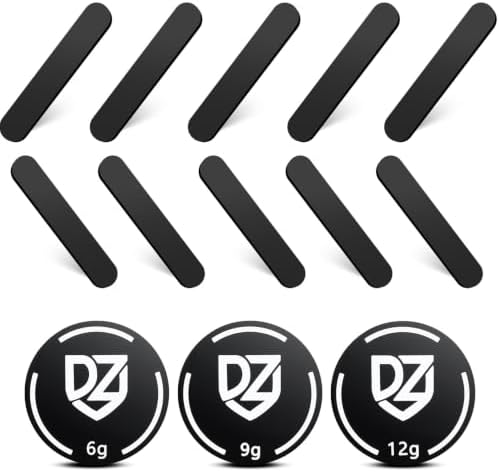
Weighting kit: DZrudun Pickleball Paddle Weights,10x3g Tungsten Tape+End Cap Coins 6/9/12g
 Visit on Amazon →
This kit gives you ten 3-gram tungsten strips plus end cap coins in 6, 9, and 12 grams. Tungsten rather than lead matters for two reasons. It is denser, so the mass sits in a smaller footprint and does not turn your edge guard into a bumper. And you are not handling lead with your bare hands in a bag that also holds your water bottle and your towel.
The coins are the half of the kit I care about most. Handle weight changes the balance point without touching the hitting surface, so it is the safest experiment a beginner can run. If your hands feel slow at the kitchen line, a coin in the end cap is a better first move than more tape on the head.
Flaws but not dealbreakers: adhesive and Florida heat are natural enemies, so check the strips before every session in the summer. The coins need a handle with a removable end cap or enough room inside it. And if you tape right at the edge guard, make sure the strip does not sit proud enough to catch the ball on a reset. Check your league's rules on paddle modifications before you bring a weighted paddle to a sanctioned event.
Anyone who wants to test weight changes in small, reversible steps will use every piece in this kit.
The setup workflow, step by step
Step one: inventory the box before you play. Count the paddles, towels, and balls. Flex each paddle face gently and look for a gap between the face and the edge guard. A warped paddle goes back. This is the one quality control step you actually control.
Step two: set up the grip. Wipe the handle with isopropyl alcohol and let it dry, then add an overgrip if your hands sweat. In humidity, a fresh overgrip is worth more than a paddle upgrade. Keep a towel in the bag and use it between points, not just between games.
Step three: find the balance point. Rest the paddle across one finger near the throat and slide it until it balances. Mark that spot with a small piece of tape on the handle. That mark is your baseline. Without a baseline, you cannot tell whether the weight you added helped or whether you just had a good night.
Step four: play two sessions at stock weight. Twenty to thirty minutes of drills is enough. Pay attention to where you miss: high on the face, low, or off to the side. Misses toward the edges mean the sweet spot is too small for you. Misses low and late mean you are late, and weight will not fix that.
Step five: add one strip, in one place. If you miss toward the edges, put one 3-gram strip at 3 o'clock and one at 9 o'clock on the head, near the edge guard and never on the hitting surface. If you want more pop and do not mind slower hands, put a strip at 12 o'clock. If you want quicker hands at the net, skip the head and put an end cap coin in the handle instead.
Step six: give it two sessions before you judge it. One session tells you nothing. Two sessions with the same partner tells you whether your timing changed or your paddle did.
Step seven: record it. Date, grams, and placement, written on your phone. Revisit in a month. If a strip has shifted or a coin rattles, fix it before you play again.
Step eight: know how to undo it. Warm the tape with a hair dryer, peel it slowly, and clean the residue with isopropyl alcohol. Keep the backing paper so you can reapply a strip you decided against. Tuning you cannot reverse is not tuning.
Where weighting goes wrong
The biggest mistake is adding head weight to a paddle that is already heavy. A wood paddle is not the place to chase power. Head weight on a slow paddle makes a slow paddle slower, and it will wreck your shoulder before it wins you a point.
The second mistake is tape on the hitting surface. Never. Weight goes on the edge guard area or inside the handle, nowhere the ball touches.
The third is total weight creep. One strip feels good, so five must feel better. They do not. Every 3 grams you add changes your swing timing, and your timing is the thing that actually wins recreational points.
The fourth is heat. Adhesive softens in a hot car, and a strip that slides mid-game is worse than no strip at all. Store the bag out of the sun and check the tape before you play.
The fifth is grip size. Anything you wrap under a grip changes the size of the handle, and a handle that is too big for your hand costs you more than any weight you can add. Keep grip changes on the outside, where you can see them.
Last, remember that weight is a feel adjustment, not a skill adjustment. If you are late on the ball, if your feet are flat, or if your grip pressure is a death grip, a heavier paddle makes every one of those problems worse.
What I left out of this guide
Composite paddles. They are the right answer for a player who has moved past beginner, and they belong in a different article. Today is about getting a workable setup and learning to tune it.
Hardware-store lead tape. It works and it is cheap per gram, but you cut it yourself, you handle lead, and you usually end up with more mass in one place than a beginner needs. Tungsten in labeled 3-gram steps is easier to reason about.
Pre-weighted pro models. You are paying a markup for weight you can add yourself with a kit and a hair dryer, and you cannot take it back out when your game changes.
Grip tape that looks great and disintegrates in a month of Florida humidity. That is a pet peeve, not a recommendation. Buy overgrips in a multipack and change them when they glaze over.
What this all costs
I am not going to quote you a number that changes next week. Both items here together come in under what a single paddle from the range I recommend to intermediate players typically runs, and the set splits four ways if you are buying for a household or a clinic.
The math that matters is not the sticker. It is the cost of the wrong purchase: the expensive paddle bought off a video that ends up in the bag because it was too much paddle for the player swinging it. Compare that to a beginner set that four people can use, plus a weighting kit that can move from paddle to paddle as your game changes, and the two-stage approach wins on cost per hour played every time.
Do stage one first. Get the set, check the edges, add an overgrip, and play twenty sessions. Then do stage two. Find your balance point, add one strip, and give it two sessions before you believe anything. Your paddle does not need to be expensive. It needs to fit the hands that are actually holding it.