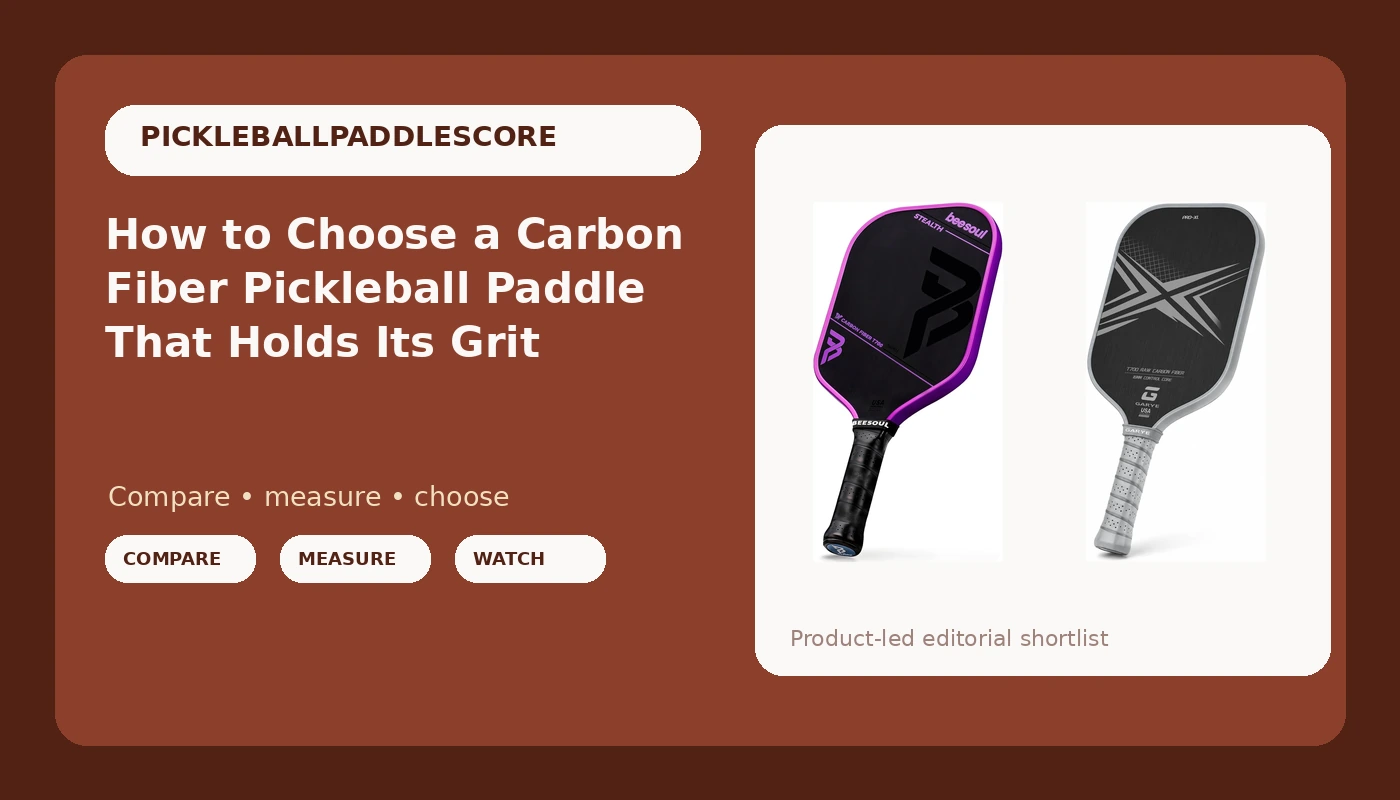
Every week someone walks into my club in Naples with a new carbon fiber pickleball paddle they bought off a thirty-second video, and every week they play the same game they played with the loaner from the demo bin. I have coached here since 2019 at a club with 400 members, and I log every paddle I demo: spin rate off a cut serve, where the sweet spot really sits, and what the edge guard looks like after three months of doubles. That log is boring. It is also the only reason I can tell you which paddles are worth your money.
Here is the short version. A carbon fiber pickleball paddle has four variables that matter: core thickness, face material, whether the body is thermoformed, and how the edge is built. Everything else on the product page is either a consequence of those four or marketing. Get them right for your game and your arm, and you will play better in two weeks than you would in a month with a paddle picked off a highlight reel.
This is the process I run with members who ask what to buy. It ends with two paddles I am comfortable handing to recreational players, and it starts with the questions you need to answer about yourself before you open a product page.
Why you should trust me
I played tennis through college, picked up pickleball in 2019, and now coach at a club with 400 members in southwest Florida. Over five years I have demoed more than 60 paddles. Every one gets the same treatment: a cut-serve spin check, a wall drill to map where the sweet spot actually sits, and a three-month watch on the edge guard and face texture through Florida humidity.
The feedback comes from both ends of the speed spectrum. My juniors tell me what feels quick at the kitchen line. The 70-and-over doubles league tells me what hurts an elbow after two hours. If a paddle only works for one of those groups, it is not an all-purpose recommendation and I say so.
I do not sell paddles, I do not run a code that adds twenty dollars to the same paddle, and I do not get paid to like anything. A paddle makes my list because it passed the log.
The four specs that decide everything
Core thickness. Sixteen millimeters is the control end of the market: bigger sweet spot, slower ball off the face, more forgiveness on off-center hits. Thirteen millimeters is the power end: faster through the air, smaller window, less help on a mis-hit. My answer for most recreational players is 16mm first. Move to 13mm only when you are consistently early on your drives and your problem is too much ball.
Face material. Raw carbon fiber gives you a textured surface that grabs the ball and holds grit longer than a painted coating. Fiberglass is softer, cheaper, and more forgiving, and it wears faster. Painted grit faces are the ones I steer players away from if they play three or more times a week, because the texture is a coating, and coatings wear off.
Thermoformed or not. Thermoforming bonds the core to the face under heat and pressure, which gives a stiffer, livelier, more consistent hit. It is the only real technology story in the last three years. It is not automatically better for you. A thermoformed paddle gives back what you put in, and if your hands are slow, that ball comes back faster than you can reset.
Edge construction. Edgeless paddles feel cleaner on off-center contact and catch fewer balls on low resets. Edged paddles protect the core and survive more court scrapes. On rough outdoor courts, an edge guard is a feature. Just watch that it does not sit proud enough to grab the ball.
How I test a paddle before I recommend it
You can run this on a demo or a friend's paddle in two sessions. It is not lab work. It is the same player swinging two paddles on the same day, which is the only comparison that means anything.
One: same player, same session. Hit twenty dinks, twenty drives, and twenty serves with your current paddle, then repeat with the new one, in that order, in one session. Anything you feel the next day is memory, not data.
Two: the wall drill. Stand eight feet from a wall and hit fifty balls without moving your feet, aiming for the same spot on the face. You will feel where the paddle goes dead. A big sweet spot feels almost the same at the edge as in the middle. A small one punishes you two inches off center, and you will know by ball thirty.
Three: the cut serve check. Serve twenty cut serves with each paddle and watch the second bounce. Spin is about 30 percent paddle and 70 percent technique, so if you cannot spin a rental you will not spin a premium paddle either. What you are testing is whether the face grabs at all.
Four: the third-month check. This is the one nobody does. After three months of regular doubles, feel the face with your thumb. Raw carbon that held up still feels like fine sandpaper. A dead face feels glassy and slick, and the ball slides on cut shots. A paddle that is gone at month three failed, no matter how good it felt on day one.
Five: the humidity grip check. Naples in July is the harshest grip test I know. If the tape gets slick or unravels within a month, replace the tape, not the paddle, and factor that into your next purchase.
Two paddles I hand to recreational players first
Both paddles below are T700 carbon fiber and both are approved for tournament play, and both fit the same profile: textured face, control-friendly core, fair price for the material. They are not identical, and the difference tells you which one is yours.
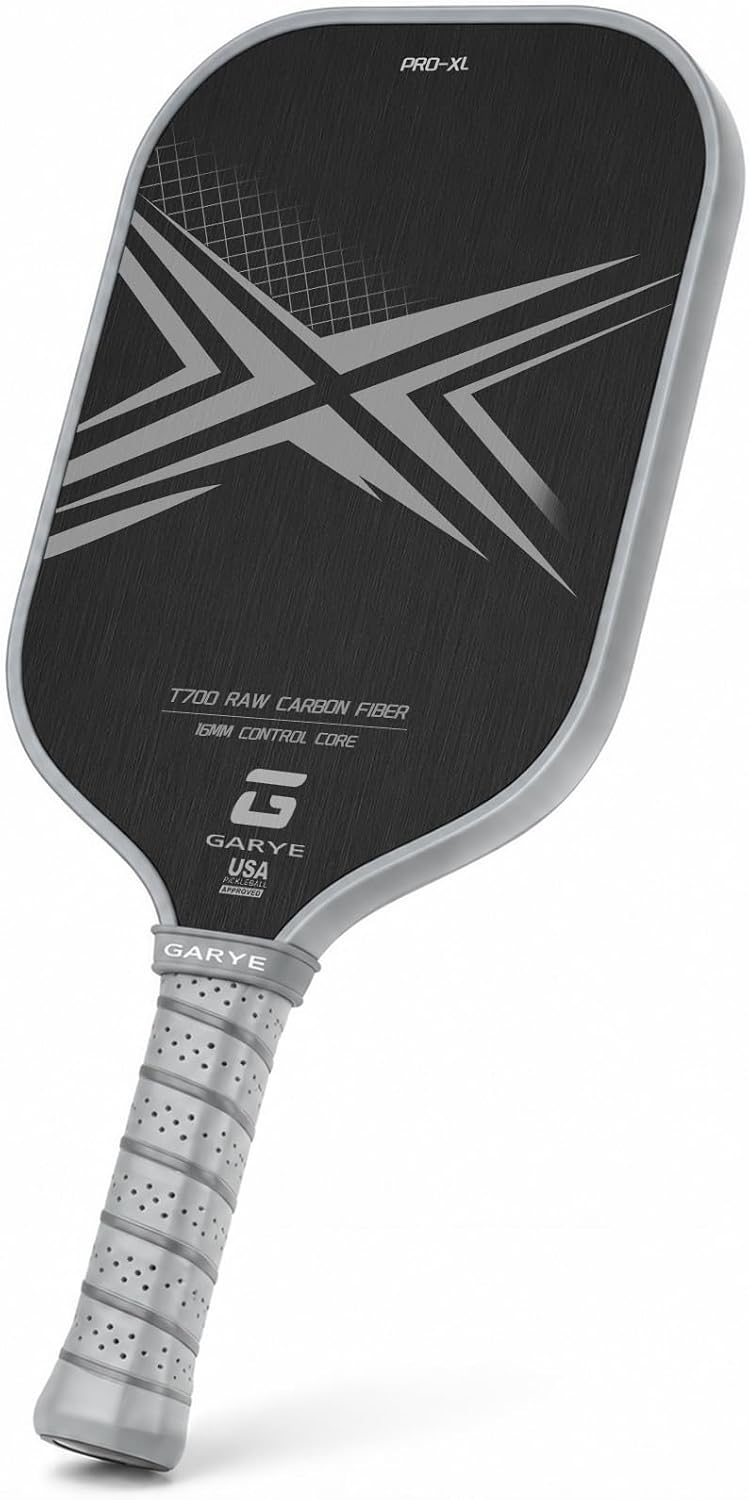
Lower-cost entry: GARYE Pickleball Paddle, T700 Raw Carbon Fiber Paddles, USAPA Approved
 Visit on Amazon →
This is the paddle I point at when a newer player wants raw carbon without betting a big number on a game they picked up six months ago. The spec sheet gives you the two things that matter at this level: a T700 raw carbon face, which is the textured surface that holds grit, and USAPA approval, so it can go into a sanctioned tournament without an argument at check-in.
The GARYE is the right starting point if you are coming from fiberglass and your complaint is that the ball does not bite on cut shots or that the face feels mushy on dinks. If you decide in a year that you want a different balance point or a heavier swing weight, you have not spent pro model money finding out.
Flaws but not dealbreakers: Raw carbon is a demanding face for a total beginner. If your only problem right now is keeping the ball in the court, a softer fiberglass paddle is friendlier for your first month. This one rewards a player who already has a swing.
Anyone on a tight budget who still wants a tournament-legal carbon fiber face should start here.
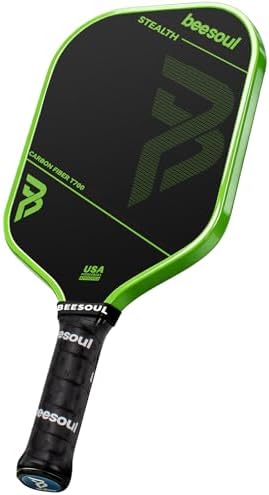
Our pick: BEESOUL T700 Pickleball Paddles Carbon Fiber 16mm, USAPA Certified
 Visit on Amazon →
The BEESOUL is the one I would hand to a player past the beginner stage who knows what they want: a 16mm core, the control end of the thickness range, and a T700 carbon fiber face, the grit end of the face range. That combination is the profile I recommend to nine out of ten recreational players.
A 16mm core widens the sweet spot and softens the ball off the face, which is what you want on dinks, resets, and third-shot drops, the shots that decide most doubles points at club level. It is USAPA certified, so tournament play is covered, and the carbon face gives you spin that a painted grit paddle loses after a few months.
Flaws but not dealbreakers: A 16mm core is not a power paddle. If your whole game is drive and crash and you want the ball to jump off the face, this one will feel polite. That is a feature for most players and a limitation for a few.
Anyone who plays three or more times a week, wants spin that lasts, and values a big sweet spot over raw pop should look here first.
The seven-step decision, in order
Run these in sequence and you will not end up with a paddle that fights your game.
One: name your actual problem. "I want more power" is usually wrong. Most players who say it are losing points on errors, not on weak drives. Write down the shot you lose points on. If it is a dink into the net, you need control and a big sweet spot, not power.
Two: pick your core thickness. Sixteen millimeters for control and touch. Thirteen for pop. If you are between the two, take the 16mm and add weight later if you want more drive.
Three: pick your face. Raw carbon if you want grit that lasts and you play often. Fiberglass if you are new or play casually. Skip painted grit if you play several times a week.
Four: decide on thermoforming. Thermoformed gives a stiffer, livelier response. If your hands are slow at the kitchen line, a non-thermoformed control paddle keeps you in more rallies.
Five: verify approval yourself. Look the paddle up on the USA Pickleball approved list before you buy. Every year I meet a player who bought a paddle that claims approval and is not on the list. That is a refund conversation, not a tournament conversation.
Six: match the grip to your hand. Hold the paddle with your index finger extended along the face. If your fingertip does not reach the edge of the face, the grip is too big. Too big means you squeeze, and squeezing means elbow pain.
Seven: demo before you commit. Ask your club or a friend for two weeks with the paddle. If you cannot demo, buy from a seller with a return window. Then run the third-month face check and ask whether you would buy it again.
What I left out of this guide
You will not find pro model paddles here. The pro model markup is the worst deal in the sport, and most of what you pay for is paint and a sponsorship budget. You will not find a recommendation built on one session either. A paddle that feels amazing for a session and dead after six weeks is a failed product, and the only way to catch that is to wait and check.
What this costs you over a season
The real cost of a paddle is not the number on the listing. It is that number divided by how many months the face stays alive. A cheap paddle with a painted grit face that goes slick in two months costs more per month of good play than a raw carbon paddle that holds its texture for a year.
The GARYE sits at the lower end of the raw carbon market and the BEESOUL sits higher, and both are a fraction of what a pro model runs. Check current Amazon price on each before you decide, then compare that against what you spend on balls, court fees, and grips in a season. If you play twice a week, the paddle is the cheapest thing in your bag.
The bigger point stands. Most players would improve more from six lessons than from a premium paddle. Buy the right spec for your game at a fair price, then spend the difference on coaching. That is the whole method.