Most pickleball paddles are sold on a feeling, and that feeling is usually manufactured by a video with a promo code in the description. I have watched a 400 member club churn through gear for six years, and the pattern never changes. A new player buys whatever the current pro is swinging, plays three sessions, and cannot figure out why the third shot keeps sailing long.
Learning how to choose a pickleball paddle is mostly about admitting what your game is right now. Not the version of your game you expect in two years. The one where your backhand dink floats and your grip is soaked by the second game of a July morning in Florida.
The good news is that the decision is far narrower than the marketing makes it look. Four things matter: the sweet spot, the weight and balance, the core thickness, and the face. Everything else, the colorway, the signature name, the word pro stamped on the throat, is packaging.
This guide walks the decisions in the order I use with new members at the club, and it points out the two paddles I would hand to two very different players at opposite ends of the market.
Why you should trust me
I am Coach Ray. I played tennis through college, picked up pickleball in 2019, and now coach at a club in Naples, Florida that runs about 400 members. Over the last five years I have demoed more than 60 paddles and kept a log on each one: spin rate off the same feeding machine, sweet spot size marked in powder on the face, and how the paddle holds up after three months of doubles. My feedback loop runs from the juniors who swing at everything to the 70 and over league that wins with placement and patience. Both ends tell me things the spec sheet never does.
I coach amateurs. I do not do pro tour predictions, and I do not compare paddles to tennis rackets, because the physics are different. What I can tell you is that the paddle market is roughly 90 percent marketing and 10 percent graphite, and the players who improve fastest are the ones who stop shopping and start drilling.
How I picked and how I tested
The two paddles below were not chosen because a score fell out of a spreadsheet I invented. They were chosen because they sit at the two ends of the market and each one answers a different question.
My demo process at the club runs on same player comparisons. One player, one ball machine, two paddles, thirty minute blocks, alternating every five minutes so fatigue does not decide the winner. That is the only way core density numbers mean anything. A paddle that feels amazing for one session and dead after six weeks is a failed product no matter how it plays fresh, so anything I recommend gets a three month doubles test before I say the name out loud.
For grips, I run everything through a Florida summer. If the tape turns to paste in June humidity, it does not matter how good the paddle is. For edges, I watch resets. An edge guard that catches the ball on a defensive reset costs you points in a way no spec sheet measures.
What I am looking for in a recommendation: a big sweet spot, a face that still has texture at the three month mark, and a price that does not include a sponsorship budget.
Two paddles that cover both ends of the market
One is the set I would hand a brand new player or a family that wants to try the sport without a commitment. The other is the paddle I would hand a player whose game is already built and who needs control more than pop.
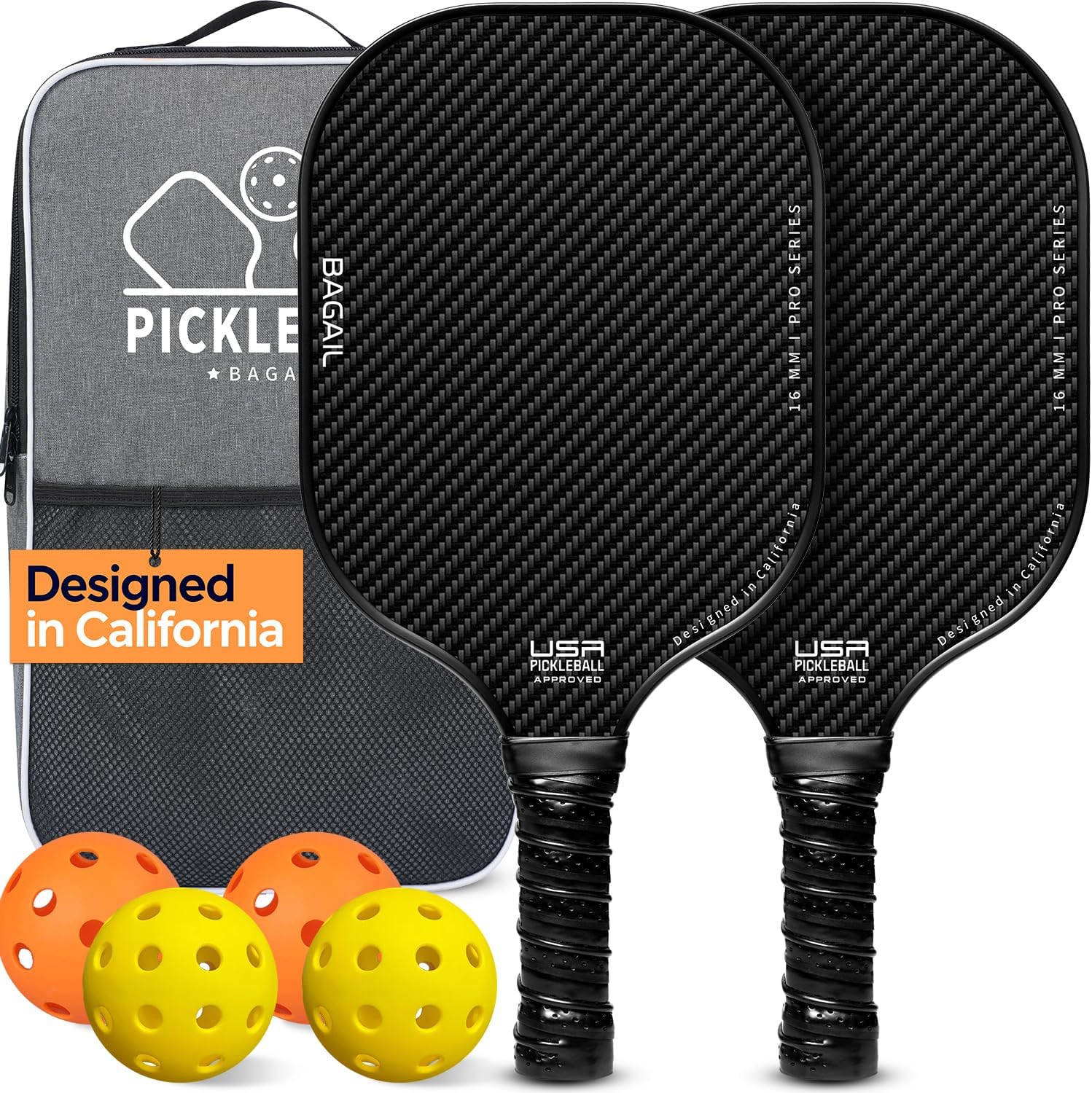
Budget pick: BAGAIL Pickleball Paddles, USAPA Approved Fiberglass Surface Pickleball Set, Lightweight Pickle Ball Rackets with 4 Balls, 1 Bag, Designed in California for Traction and Stability
 Visit on Amazon →
This is a complete starter set with a fiberglass surface and a lightweight build, sold with four balls and a carrying bag, positioned by the maker around traction and stability. For a first paddle, that combination is the right one. Fiberglass gives you a livelier face than the cheapest composite options, the light weight keeps the paddle from dragging your wrist down while you are still learning the stroke, and buying the whole set means a spouse or a friend can play the same day it arrives.
The honest caveat is that a set at this end of the market is built to a budget, and the place that shows up first is the grip. Factory tape on any inexpensive paddle is the first thing I replace, and in Florida humidity it is not optional. Budget for a couple of overgrips in the same order.
One more thing, and this is my biggest pet peeve in the sport: verify the approval yourself. Any listing can say approved. The USA Pickleball approved paddle list is public and searchable, and it takes ninety seconds to check the exact model before you buy, including this one. If a paddle arrives and it is not on the list, send it back.
Who this is for: a first time player, a couple, a family, or a club that wants loaner paddles for guests. Check current Amazon price.
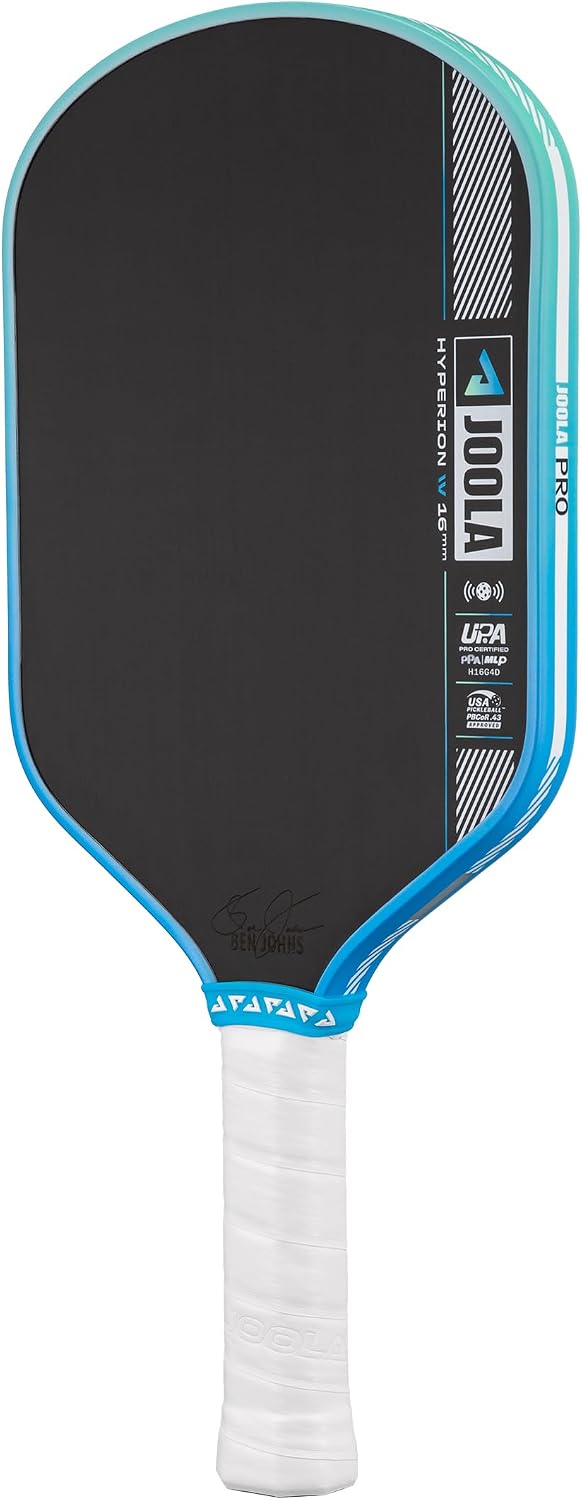
Upgrade pick: Ben Johns Hyperion Pro IV 16mm Pickleball Paddle - Lime Pop
 Visit on Amazon →
This is the other end of the market: a signature pro model with a 16 millimeter core in the Lime Pop colorway. The 16 millimeter number is the part that matters to your game. A thicker core is the control side of the trade. You get a softer feel at contact, a more forgiving response when you catch the ball off center, and less free pop, which is exactly what a player with developed strokes wants on dinks, resets, and third shot drops. Thin cores hand you power you then have to manage. Thick cores hand you a sweet spot you can lean on.
Who this is for: the 4.0 and up doubles player, and honestly a good chunk of the 70 and over crowd at my club, whose entire game is placement. If your mechanics repeat and you generate your own pace, a control oriented pro model like this one rewards you. If your main problem is that you are late to the ball, no paddle fixes that, and this one will feel like it has no power because it is not doing the work for you.
The caveat is the one I give every member: pro model pricing is the worst deal in the sport for most recreational players. You are paying for a signature and a small amount of engineering. Buy it because the control profile fits your game, not because of whose name is on it. Demo it first if you can. Check current Amazon price.
The step by step process
The order matters. Do these in sequence and you will not end up with a paddle that fights your game.
Step one: Write down what you actually are. Your level, your style, and the shot that loses you the most points. If you cannot answer that, borrow a paddle and play three sessions before spending anything.
Step two: Grip size. Wrap your hand around the handle. There should be roughly a finger's width of space between your fingertips and the base of your palm. Too small and you will squeeze, which is how elbows get sore. Too large and you lose wrist snap on serves.
Step three: Weight and balance. Light and head light is for quick hands at the kitchen line. Heavier and head heavy is for stability against pace. If you play mostly doubles and you are over 50, err light.
Step four: Core thickness. This is the real decision. Thick cores are control and forgiveness. Thin cores are pop. Match it to the shot you need most, not the shot you enjoy hitting most. Sweet spot size beats raw power for nine out of ten players I coach.
Step five: Face. Fiberglass is the value play, with a livelier response and a lower price. Carbon and graphite faces cost more and can generate more grit, but texture wears. A face that is smooth at three months is a different paddle than the one you bought, so clean it, and check the texture by feel every few weeks. And remember that spin is about 30 percent paddle and 70 percent technique. I can put more spin on a rental paddle than most players get from a flagship.
Step six: Edge. Edged paddles have a guard, which protects the core but can catch the ball on low resets. Edgeless paddles are cleaner on defensive scoops but chip more. If you play a lot of defense, decide which one you are willing to live with.
Step seven: Demo, and demo the right way. Same player, same ball, alternating paddles in the same session, not one paddle today and the other next week. A paddle that feels amazing for one session and dead after six weeks is a failed product, so ask about durability and check the return window before you order.
Step eight: Buy once, then stop shopping. Replace the grip tape, add edge tape if you play on rough courts, and recheck the face at three months. Then spend the next six months on lessons and drilling, because that is where the rating comes from.
What I would skip
Skip the influencer code. It is the same paddle with a markup baked in and a discount that brings it back to retail.
Skip the power claims. There is no paddle in the world that fixes late contact.
Skip the pro badge unless the core thickness actually matches your game. The markup is real and the engineering difference is small.
Skip buying new at full retail on hype models. Watch the used market for last year's hyped paddles at half price. That tells you what held up and what did not, and it is the cheapest education in the sport.
Skip the gear arms race generally. I would rather see a member spend on four lessons than on a paddle upgrade, and I say that knowing the best players at my club do play expensive paddles. Both things are true. Beginners get better from coaching. Advanced players get better from a control paddle with a big sweet spot.
What this all costs
Two data points, no prices invented: the BAGAIL set and the Ben Johns Hyperion Pro IV both list their current numbers on their Amazon pages, so check current Amazon price on each and do the math against your own budget.
The way I frame it for members is cost per session. A set that covers two players and includes balls and a bag spreads over every session you play this year. A pro model spreads over the same sessions from a much higher entry point, and it only makes sense if control is the thing your game is missing.
Then add the boring line items nobody budgets for: a pack of overgrips every couple of months in a humid climate, a replacement grip once a year, and edge tape if you play on courts that chew up guards. Those are the costs that keep a paddle playable for three years instead of one.
If your total gear budget for the year is tight, spend it in this order: a durable paddle that fits your level, overgrips, then lessons. The paddle is the tool. The lessons are the rating.
Nobody ever lost a match because their paddle was the wrong color. Plenty of players lose because they bought power they cannot control, or because the grip turned to paste in July, or because the face went smooth and they never noticed.
Choose the sweet spot first, the core second, and the signature last. Then put the paddle down and go drill. That is how to choose a pickleball paddle, and it is also how to stop buying them.