Most players buy a carbon fiber pickleball paddle the same way they buy a car. They walk in with a color in mind, listen to whoever talks loudest, and leave with something they cannot explain a month later. Then the paddle gets blamed for the backhand.
I coach at a 400 member club in Naples, Florida, and I have watched that loop run for six years. The paddle is almost never why someone plateaus. It is often why their elbow hurts, why their resets pop up, or why they feel late at the kitchen line. So the decision matters, just not in the way the product pages frame it.
When you buy a paddle you are really choosing four things: the size of the sweet spot, the thickness of the core, the material and texture of the face, and how the whole thing is built at the edge guard and the grip. Everything else on the listing is decoration.
Here is the order I use when a member asks me how to choose, plus two paddles that fit these criteria closely enough that I use them as reference points at the demo table.
Why you should trust me
I am 52, I played tennis through college, and I picked up pickleball in 2019. I now coach at a club with 400 members, which means I see the same mistakes across every age bracket from the juniors to the 70-and-over league.
Over five years I have demoed more than 60 paddles. I keep a log on each one: spin rate off the face, how the sweet spot feels on off-center contact, and what the paddle looks like after three months of doubles play. The juniors tell me when a paddle is too hot to control. The 70-and-over group tells me when one is too heavy by the third game of a round robin. Both ends of the speed spectrum feed the same notebook.
I am not a brand ambassador. I do not hand out codes, I do not get paid to like anything, and I will tell you when a paddle you already own is fine.
The four things that actually decide how a paddle plays
Sweet spot size. This is the number one factor for anyone below a 4.5 rating, and it is the one nobody advertises because it is hard to put on a box. A bigger sweet spot means your mishits stay in play. Power you cannot control is not power, it is unforced errors with extra pace. If you are choosing between a paddle that feels forgiving and a paddle that feels explosive, take the forgiving one and spend the difference on a lesson.
Core thickness. Thicker cores give you a softer, more forgiving response and better stability on blocks and resets. Thinner cores give you a faster, crisper feel that some players love on drives and hand battles. A 16mm core is the safer starting point for doubles players who win points by extending rallies. A thinner core suits the player who ends points early and does not mind a smaller margin for error.
Face material and texture. This is where carbon fiber earns its reputation. A woven carbon face with a textured surface grabs the ball a little longer on contact, which helps you shape shots. But be honest with yourself: spin is roughly 30 percent paddle and 70 percent technique. I can put more spin on a rental paddle than most club players get from a paddle that costs three times as much. Fix your contact point first, then buy the face.
Edge guard and grip. These are the two parts that fail first, and they are the two parts nobody puts in the headline. A raised edge guard that catches the ball on low resets is a real problem, not a cosmetic one. A grip that turns slick in Florida humidity will cost you more points than a slightly smaller sweet spot ever will. Edges chip and faces wear. The brands that fix their edge guards are the ones that get my repeat recommendations.
How to choose, step by step
Step one: be honest about your game, not your aspirations. Write down how you actually win points. If you win by keeping the ball in play and moving people around, you want control and a big sweet spot. If you win by ending points at the kitchen line, you can trade some forgiveness for hand speed. Most players I fit overestimate their power game by a full rating point.
Step two: pick core thickness before you pick a brand. Thickness shapes the feel more than any logo does. Thicker for control, thinner for speed. Decide this first, and half the market disappears, which is a good thing.
Step three: match the face to how you generate spin. If you already hit with heavy topspin, a textured carbon face will reward you. If your spin comes mostly from low-to-high technique that you are still building, a textured face will not fix a flat swing, and a heavily textured face that wears smooth in a couple of months is money gone. Ask what the face looks like after 90 days of play, not after 90 minutes.
Step four: check the edge guard and the grip in your hand. Run your thumb along the edge. If it sits proud of the face, it will catch balls on low resets. Then grip the handle and swing it once. If the grip feels like a wet bar of soap in an air-conditioned shop, imagine it in August.
Step five: demo before you buy, or buy where you can return. Every club with a pro shop should have a demo program. If yours does not, ask for one. Buying blind from a video is how members end up with three paddles and no idea which one they play best with. If you must buy online, buy from a listing with a return window long enough to play three real sessions.
Step six: re-check at six weeks. A paddle that feels amazing in session one and dead by week six is a failed product, no matter how it played fresh. Mark your calendar. Check the face texture, the edge guard, and whether the grip has gone slick. That is the data that should drive your next purchase, not a launch video.
Two paddles that fit this process
These two are not the only good options on the market, and they are not the right answer for everyone. They are simply two paddles that line up with the criteria above from opposite directions: one built around a thicker, more forgiving core, and one built around the face.
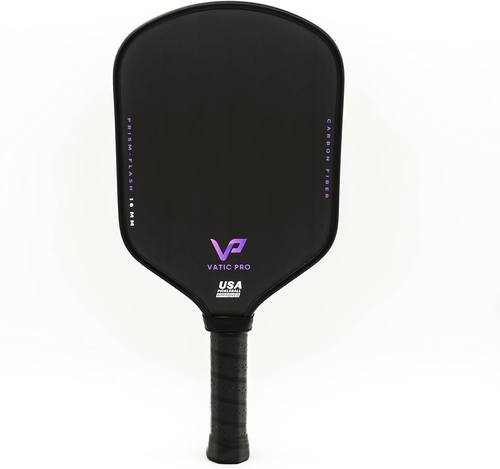
Control-first pick: Vatic Pro Prism Carbon Fiber 16mm - Foam Injected Walls - Includes Paddle Cover
 Visit on Amazon →
This is the shape of paddle I hand to a doubles player who wins by extending rallies. The listing describes a 16mm core with foam injected walls and a carbon fiber face, plus a paddle cover in the box. The 16mm core is the part that matters for most recreational players: thicker cores tend to feel softer on blocks and more stable when the ball catches you off center, which is exactly what happens in a fast exchange at the net.
The foam injected walls are worth understanding rather than repeating. Filling the walls is a build choice aimed at damping the hollow, pingy feel that some carbon paddles have and at stiffening the perimeter. In plain terms, it is a comfort and stability feature, not a power feature. If you have elbow or wrist sensitivity, that is a legitimate reason to care.
The included cover is a small thing that turns out not to be. Paddles that ride loose in a bag next to water bottles and car keys are the ones with chewed edge guards by midseason.
Flaws but not dealbreakers: A 16mm core is not the fastest option through the air. If your whole game is crashing the kitchen line and trading hands, you may prefer something thinner. This is a paddle for the player who wants the ball to land, not the player chasing top speed.
Recreational and intermediate doubles players who want a forgiving sweet spot and do not want to think about their paddle again for a year should start their shortlist here.
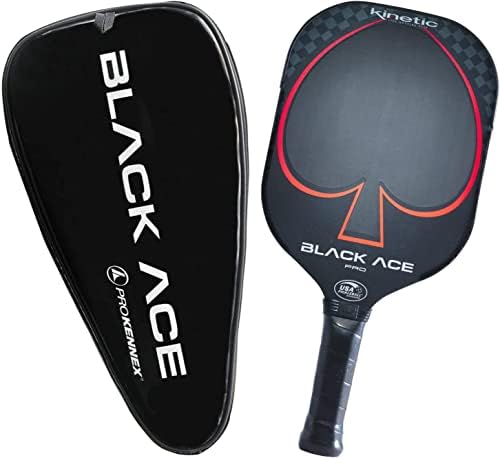
Face-first pick: PROKENNEX Black Ace Pro - Pickleball Paddle with Toray 700 Carbon Fiber Face - Comfort Pro Grip
 Visit on Amazon →
This one leads with the face. The listing names a Toray 700 carbon fiber face and a comfort pro grip, which tells you where the design priority sits: contact feel and handle comfort. Toray 700 is a specification worth recognizing because it tells you what class of carbon you are paying for, and carbon faces in this class are chosen for the way they grip and return energy on contact rather than for raw pop.
The comfort grip is the detail I would point a club player toward, because grip is a wear item and a maintenance decision. A grip that holds up in humid conditions means you are not re-taping the handle every three weeks, and a handle that stays comfortable in your hand means you are not adjusting your swing to compensate for a grip you do not trust.
Flaws but not dealbreakers: Textured carbon faces are the part of a paddle most likely to wear down with heavy use, so how long that surface stays effective depends on how often you play and how you care for it. Wipe it down, keep it out of a hot car, and check the texture yourself at the six-week mark.
Players whose first question about any paddle is how it feels on contact, and who want the handle to stay comfortable through a Florida summer, should look closely here.
Where players overspend
The big paddle brands are fine. The pro model markup is the worst deal in the sport right now. You are often paying for a paint job, a signature, and a sponsorship budget, not a different core.
Influencer codes are the second trap. A code that saves you ten percent on a paddle whose price was raised twenty dollars for launch season is not a discount, it is a rounding error with a countdown timer.
The third trap is buying a paddle before you have a repeatable swing. I would rather see a member spend a season on a mid-price paddle with a big sweet spot and put the rest into lessons. The player who fixes their third shot drop will beat the player with the expensive paddle nine times out of ten.
One last thing, and this is a pet peeve of mine: if a listing claims approval from a governing body, go verify it on the official list yourself. Paddles that claim approval and arrive without it are a real problem in this sport, and it takes two minutes to check.
Questions I get in the parking lot
Do I need the most expensive paddle to beat my friends? No. The player with the better third shot and fewer unforced errors wins. Sweet spot size beats raw power for nine out of ten players, and you do not need power you cannot control.
How long should a paddle last? Long enough that you are not shopping again next season. Judge it on the edge guard, the face texture, and the grip, not on how it felt in the first week. A paddle that is dead in six weeks failed, regardless of the launch reviews.
Should a beginner buy carbon fiber? A textured carbon face will not hurt you, but it will not teach you spin either. Buy a forgiving core first, learn to make clean contact, and let the face become the upgrade once you know what you are upgrading for.
The bottom line
Choosing a paddle is a short list of decisions, not a research project. Pick the core thickness for your actual game, pick the face for how you generate spin, then check the edge guard and the grip with your own hands. Demo if you can, buy where you can return, and re-check everything at six weeks.
Do that and you will stop shopping every season. The paddle will stop being the variable, and your game will be the only thing left to work on. That is where the improvement actually lives.